Men’s Watches Virtual Try On RFP — Template & Implementation Brief
Introduction — download the RFP brief (men’s watches virtual try on rfp). You’re drafting a men’s watches virtual try on rfp to evaluate vendors fast — download the editable RFP brief and try on proposal template now (gated). tryitonme.com is a no-code, link-based virtual try-on (VTO) platform for eyewear, jewelry, watches and hats — designed to launch via a shareable product link without SDKs or APIs. Get the templates (Word & Google Doc) and a scoring matrix to standardize vendor comparisons. Download the RFP brief.
Quick Summary
- Download editable RFP and proposal templates to consistently assess VTO vendors.
- Choose between SDK/API and no-code link-based implementations—for quick trials, link-based is recommended.
- Demand validated KPIs and export raw events; don’t accept uplift claims without data.
- tryitonme.com provides a no-code, shareable link solution for quick investment in men’s watches.
Introduction & Download
Download the editable RFP brief and try on proposal template (gated). The package includes Word & Google Doc templates and a scoring matrix so procurement can compare vendor responses consistently. Get the gated files and sample links at cermin.id/tryitonme-watches-virtual-tryon.
Why VTO is essential for men’s watches (virtual try on RFP template)
Watches are a high-consideration accessory: shoppers judge case diameter, strap fit, lug-to-lug, finish, and how a watch sits on their wrist. Those fit and style questions cause hesitation that affects conversion and returns. Your virtual try on rfp template should tie the VTO project to measurable business outcomes — conversion uplift, reduced returns, higher AOV, and consistent omnichannel presentation — and require vendors to commit to KPIs and raw data exports. For guidance on tying project goals to KPIs and RFP best practices, see the Search Laboratory RFP template and an RFP overview at HigherVisibility. Refer to the ROI overview at cermin.id/roi-mens-watches-virtual-tryon for watch-specific impact notes.
What shopper friction looks like for watches
- Case size and wrist proportion uncertainty (visual scale).
- Strap/bracelet fit and material appearance in context.
- Metal finish and dial prominence under real-world lighting. See reflections & lighting
Link these pain points to measurable outcomes in your RFP; ask vendors for baseline-to-pilot measurement and raw event exports so you can validate vendor claims (no invented uplift numbers here — require commitments and data).
VTO deployment options: SDK/API vs no-code, link-based (men’s watches virtual try on RFP)
When you ask vendors to describe implementation approaches, require both a custom SDK/API option and a no-code, link-based option. Implementation choice drives time-to-market, engineering effort, and channel distribution.
Comparing approaches (high level)
SDK/API integration
- Best for: enterprises with engineering bandwidth that need deep control and brand-level customization.
- Pros: tighter UX control, deeper platform integration.
- Cons: longer build, higher maintenance, dependency on engineers.
No-code, link-based deployment
- Best for: faster pilots, campaign activation, social and mobile distribution.
- Pros: rapid launch, shareable product links, low engineering overhead.
- Cons: less bespoke engineering flexibility than a full SDK.
For implementation considerations and RFP wording around these tradeoffs, reference Codedesign’s RFP implementation guide and a practical explainer on implementation tradeoffs (YouTube). For most watch brands running a pilot or seasonal campaigns, the no-code, link-based approach is the recommended default because it prioritizes speed, shareability, and cross-channel use. Read on for how to ask for it in your RFP.
Why tryitonme.com is the Right Fit for Your Business (try on proposal template)
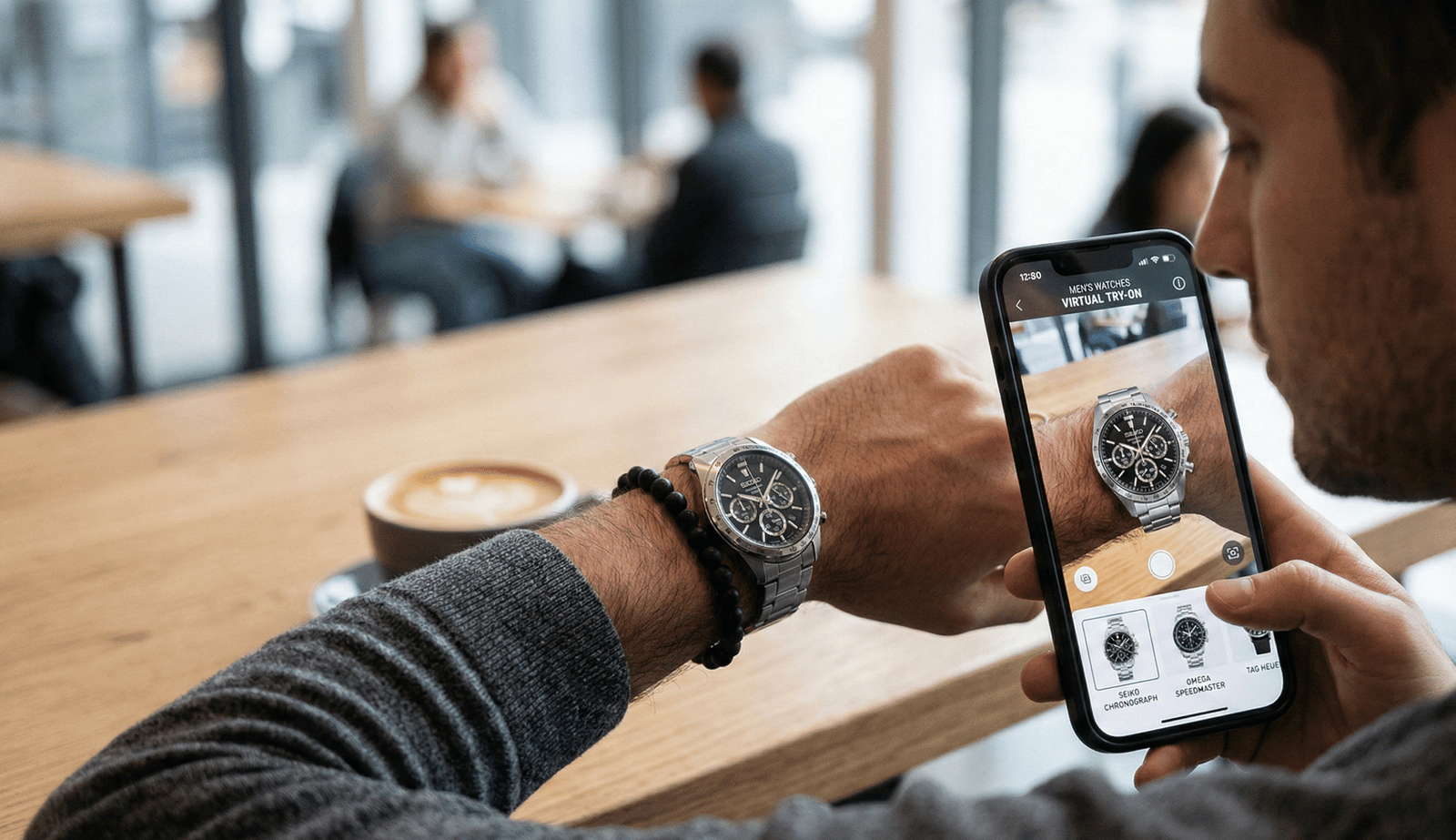
tryitonme.com offers a procurement-friendly, no-code VTO option that matches the needs of product and marketing teams. Request a live sample product try-on link for a men’s watch and evaluate the experience with your stakeholders: tryitonme.com. Book a Demo via the link.
- ZERO-CODE, LINK-BASED deployment — no SDK or API required; works via a shareable product link.
- Fast onboarding workflow:
- Purchase a 6-month package based on SKU quantity.
- Send standard product photos (e.g., front/side for eyewear; for watches include front + strap variants).
- tryitonme.com team/AI handles all AR processing.
- Receive a unique, ready-to-use try-on link in under 3 business days.
- Cross-channel compatibility — the same shareable link works on web, mobile, and social, reducing engineering and launch risk.
- Procurement-aligned priorities — speed, predictability, and clear time-to-value.
What to include in a “men’s watches virtual try on RFP” — the core checklist
Use the following sections (and paste them into the downloadable virtual try on rfp template) so vendor responses are comparable and procurement-ready. The RFP structure guidance from Search Laboratory is helpful for overall template and question examples: Search Laboratory RFP template and Codedesign provides structure guidance: Codedesign guide.
Project overview & objectives (men’s watches virtual try on RFP)
- Background: brand, channels, customer segments.
- Business problem: returns, low PDP conversion, or campaign activation.
- Measurable objectives: list primary KPIs (conversion, returns, AOV) and pilot expectations.
- Pilot scope: SKU count, markets, languages.
- Expected go-live window and pilot duration.
Scope of work (virtual try on RFP template)
- Product catalog size for pilot and full rollout.
- Asset needs: required photography views (for watches: front + strap/bracelet variants) and any 3D/GLTF expectations.
- Variant handling: case sizes, dial colors, strap types.
- Calibration and scale requirements: how the watch maps to wrist size.
- Localization: language and regional variants.
Functional requirements (try on proposal template)
- Link-based product try-on integration (no SDK required option).
- Mobile-first AR or 2D overlay support.
- Variant switching and product option mapping.
- Shareable links with deep-linking for campaigns. Shopify guide
- Compatibility with social in-app browsers and messaging.
UX requirements (virtual try on RFP template)
- Fast first interaction and low friction entry points on PDPs. UX notes
- Accessible UI patterns and localized copy.
- Clear calls-to-action from try-on to add-to-cart.
- Degraded experience plan for unsupported browsers/devices.
Technical requirements (men’s watches virtual try on RFP)
- Supported browsers and OS (ask vendor to list).
- Performance targets for load and interaction (vendor to commit).
- CDN / asset delivery expectations.
- Staging environment and release management process.
- Supported asset formats (images, 3D models — ask vendor to specify).
Analytics & integrations (virtual try on RFP template)
- Required event schema (try_start, variant_selected, share_click, purchase_after_try).
- GTM and GA4 support; Conversion API capability.
- Customer ID mapping and attribution rules.
- Raw event export cadence (daily/weekly) and format (CSV/JSON).
Security & compliance (try on proposal template)
- PII handling, GDPR/CCPA alignment, cookie-consent behavior.
- Vendor security documentation (SOC/ISO attestations if available).
- Data retention and breach-notification commitments.
Service levels & support (virtual try on RFP template)
- Uptime expectations and SLA response times.
- Named support contacts and escalation path.
- Release cadence and maintenance windows.
Testing & QA (men’s watches virtual try on rfp)
- Device and browser matrix for QA.
- Acceptance criteria for pilot and bug severity definitions.
- Accessibility checks and performance validation.
Intellectual property & asset ownership (try on proposal template)
- Ownership of provided images and derivative assets.
- Rights to custom calibrations and produced overlays.
- Data ownership and export rights.
KPIs and measurement (what to ask vendors to commit to)
Ask vendors to commit to primary and secondary KPIs and to provide the raw event feed so you can validate impact.
Primary KPIs (require vendor commitments and raw data)
- Conversion rate uplift (vendor to define baseline and delta).
- Add-to-cart uplift.
- Engagement: try-on starts per product view.
- Return rate impact.
- Average order value change.
- View-to-purchase rate for shared links.
Secondary metrics
- Time-to-first-try.
- Share rate and assisted conversions.
- Variant selection and try-on completion rate.
Reporting cadence
- Weekly dashboard during pilot, monthly business review after launch.
- Raw event export by event type, timestamp, product, and session.
See guidance from Search Laboratory and measurement advice from Codedesign.
Timeline & milestones to include in the RFP (sample schedule)
Provide vendors a timeline window so responses are comparable. Suggested milestone ranges (not guarantees):
- Discovery & onboarding: 1–2 weeks.
- Asset prep & calibration: 2–4 weeks.
- Pilot & QA (subset of SKUs): 2–4 weeks.
- Go-live & initial monitoring: 1 week.
- Optimization & scale: ongoing monthly sprints.
A typical pilot schedule often falls in a 6–10 week range with a broader rollout in 2–3 months depending on asset readiness and approvals. Reference HigherVisibility for timeline guidance and implementation tradeoffs (video).
Budget & pricing models to request (try on proposal template)
Require vendors to quote multiple pricing models and provide a line-item TCO:
- Pricing models to request: per-SKU, per-session, flat subscription, revenue share, hybrid.
- Line-item TCO: setup, asset prep/calibration, recurring fees, integrations, support, optional expansion. Pricing guidance and tryitonme pricing.
Vendor evaluation criteria & scoring matrix (virtual try on rfp template)
Use a weighted scoring approach and define pass/fail items (security and analytics export). Example weights (adjust to your priorities):
- Fit for men’s watches: 20%
- Speed to implement: 15%
- Cross-channel sharing & link-based deployment: 15%
- Analytics depth & event tracking: 15%
- Security & compliance: 10% (pass/fail minimum)
- References & case studies: 10%
- Pricing transparency: 5%
- Commercial terms & ROI evidence: 10%
For evaluation best practices, see HigherVisibility and SEO RFP examples at iPullRank. Use the men’s watches try on vendor checklist for a focused shortlist and pass/fail screening: vendor checklist. Consider platform comparisons (e.g., tryitonme watches vs wanna) when scoring provider accuracy and UX: comparison.
How to structure the vendor response (try on proposal template)
Require a consistent response format so procurement can compare apples-to-apples:
- Executive summary.
- Technical approach and deployment options (SDK/API and no-code link-based).
- Proposed timeline and milestones.
- Sample statement of work.
- KPI commitments and reporting cadence.
- References and case studies.
- Live demo link (shareable try-on link) — essential for no-SDK evaluation.
- Pricing by model and assumptions.
- Legal and security documentation.
Downloadable assets & CTA
The gated download includes:
- Editable virtual try on rfp template (Word & Google Doc).
- Editable try on proposal template (Word & Google Doc).
- KPI dashboard template (Sheets/Excel).
- Vendor scoring matrix (Sheets/Excel).
- Sample timeline Gantt file.
- One-page procurement checklist for men’s watches VTO.
Form fields on the gated page: company, role, email, SKU count, target timeline. After form submission, the files are delivered by automated email and you can opt to book a live demo. Download the pack: Get the gated files. Book a tryitonme demo: tryitonme.com.
Sample “try on proposal template” highlights (try on proposal template)
Ask vendors to provide:
- A shareable demo link (no-SDK option strongly preferred).
- KPI commitments for a 60–90 day pilot.
- Full asset requirement list and turnaround times.
- Rollout assumptions by SKU count and cost per SKU.
- Proof of analytics and raw event export.
For tryitonme.com, request a live shareable product try-on link to evaluate without engineering: tryitonme.com.
Visual assets to include in the post (virtual try on rfp template)
- Mobile screenshot of a men’s watch try-on via shareable link.
- Desktop screenshot of product detail page with try-on CTA.
- KPI dashboard screenshot.
- Sample vendor scoring table visual.
Include accessible alt-text that references the keywords naturally (page title/meta and two image alts to reference the three primary keywords).
Closing & conversion path — next steps for procurement teams
A link-based, no-code VTO is often the fastest path to test impact for men’s watches: it lowers engineering risk, accelerates campaigns, and enables stakeholder evaluation via a shareable link. Next steps:
- Download the gated “virtual try on rfp template” and “try on proposal template” to standardize your solicitation (download: cermin.id).
- Book a live tryitonme.com demo to receive a sample men’s watch try-on link (tryitonme.com).
The gated form will ask for company, role, email, SKU count and timeline; you’ll get the files by automated email and can opt for a 15–30 minute fast-start audit.
SEO & editorial checklist for this post (virtual try on rfp template, try on proposal template)
- Use “men’s watches virtual try on rfp” in the H1 and first paragraph.
- Include “virtual try on rfp template” and “try on proposal template” in at least one H2/H3 and in CTAs.
- Ensure meta description and two image alts reference the keywords.
- Word count target: ~1,800 words (this draft meets that target).
- Place prominent download CTA near top and bottom; gated form + automated email + optional calendar link.
FAQs
1. What is link-based virtual try-on and why is it important?
Link-based VTO is a no-code solution that outputs a shareable URL for each product so users can try the item without SDK integration; it’s important because it speeds up pilots, simplifies social distribution, and reduces engineering overhead.
2. How fast can I get the sample try-on link from tryitonme?
According to the tryitonme onboarding process, after submitting standard photos and ordering a package, you can receive a try-on link in less than 3 business days. To request a demo, visit tryitonme.com.
3. What KPIs should be requested in the RFP?
Ask for commitments to primary KPIs such as conversion uplift, add-to-cart uplift, engagement (try-starts per view), return rate impact, and AOV change. Also, request raw event exports so claims can be validated.
4. Should we choose SDK/API or link-based for the pilot?
For pilots and quick campaigns, no-code link-based tools are recommended because they’re quick and easy to share. Choose an SDK/API if you need in-depth UX control and tight platform integration.
5. What is the best way to assess vendors in the scoring matrix?
Use measurable weights (e.g. fit for watches, speed to implement, analytics depth), define pass/fail for security and data export, and request a live demo link as proof of operation.
6. What are the specifications of the underlying assets that must be prepared?
For watches: front photo + strap/bracelet variants; if the vendor requires 3D/GLTF, request a complete list of formats and turnaround options. Include an asset checklist in the RFP attachment.
Download the editable virtual try on rfp template and try on proposal template now (gated) — then book a tryitonme demo to get a live men’s watch try-on link and a 15–30 minute fast-start audit: Download & Book Demo • tryitonme.com.