2D vs 3D Try On Bangles
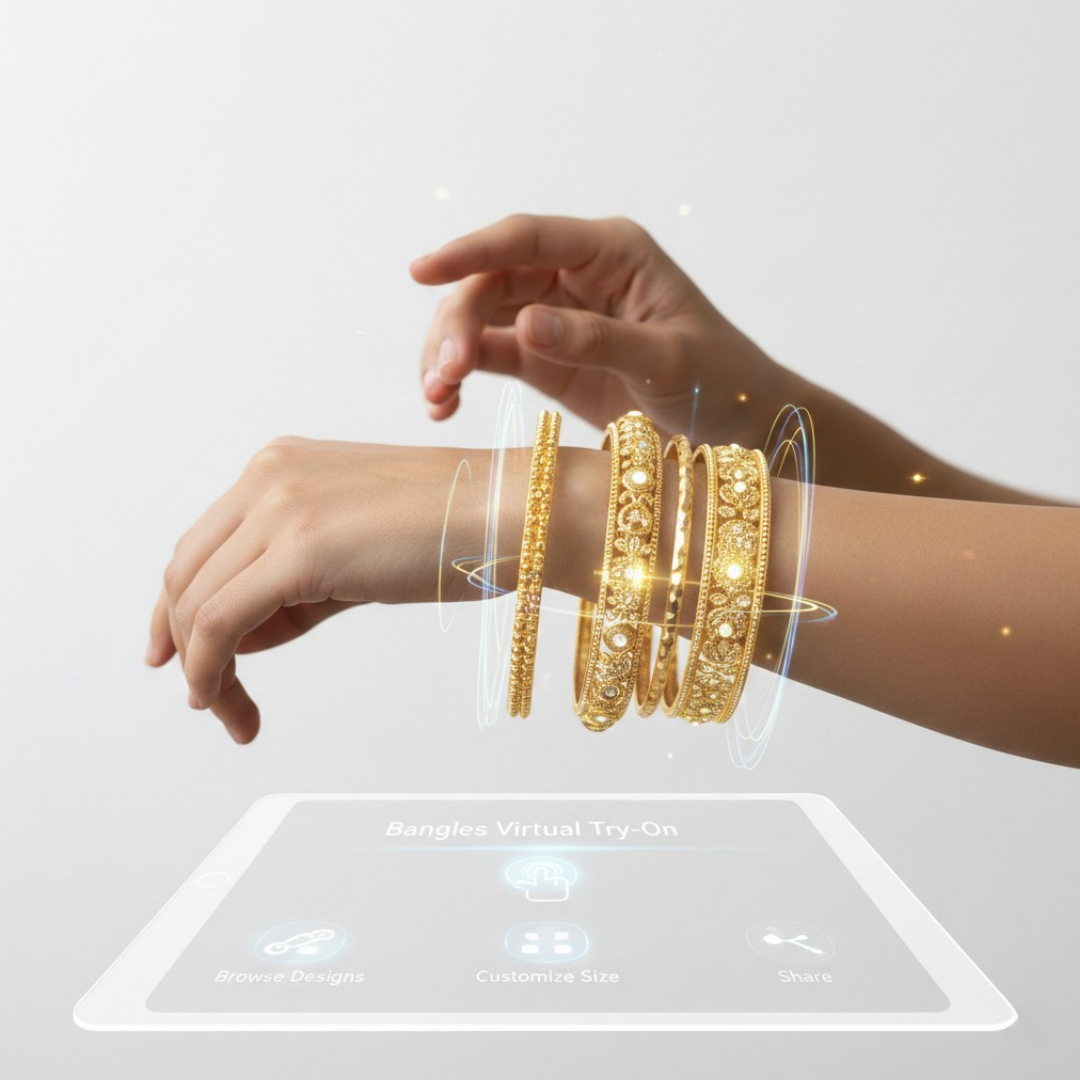
2d vs 3d try on bangles is a key decision for jewelry retailers launching virtual try‑on.
- 2D compositing = fastest to market and lowest cost — great for large catalogs and social traffic.
- 3D models = higher realism for reflective, sculptural, or premium bangles where rotation and lighting matter.
- Best practical approach: hybrid — 2D for scale, 3D for hero/high-value SKUs.
- Test both via link-based tools (for example, tryitonme.com) before committing to heavy production.
What are 2D try on and 3D try on?
2D try on: A compositing approach that overlays a product cutout or image onto a shopper’s photo or live camera view using transforms (scale, rotate, warp). It’s image-based and typically faster to produce — see workflow context at The 1916 Company and retailer examples at Plumb Club.
3D try on: A rendering approach using geometry, materials, and a 3D scene. The asset can respond to camera angle, wrist motion, and lighting for true rotation and parallax. More realistic but requires modeling/scanning and more compute — overview and bracelet context at The 1916 Company and TouchTry.
Hero GIF (side-by-side): left = 2D overlay; right = 3D rotation.


Why bangles are a special case
Bangles combine geometry, fit, optics, and occlusion in ways that reveal compositing shortcuts quickly. Key challenges and their impact:
- Circular geometry → small placement errors look obvious. (See geometry/fitting context: Mathgrrl.)
- Occlusion (hands, sleeves) → parts of the bangle may be hidden depending on pose; requires reliable wrist tracking.
- Reflective finishes → lighting mismatches are obvious; 3D rendering with tuned materials often looks more convincing for polished metals.
- Fit expectations → shoppers care how the piece sits (loose vs snug). Fit notes: Yearly Co.
Challenge → Impact checklist
- Complex geometry → likely 3D
- Highly reflective surfaces → lean 3D (or advanced 2D with matched lighting)
- High SKU count, limited budget → 2D for scale
- Social ads / fast campaigns → 2D for speed and low friction
Pros and cons — practical comparison
2D try on — pros
- Fast to implement and test across many SKUs (examples).
- Lower production cost; leverages standard product photos.
- Small asset size → lighter payloads and faster load times.
Best use: scale, social campaigns, and catalog coverage.
2D try on — cons
- No true rotation or depth (limited parallax). (limitations overview.)
- Can look “pasted on” for reflective or sculptural pieces.
- Harder to handle complex occlusion and variable wrist poses.
3D try on — pros
- True rotation, better spatial realism, and realistic lighting/shading. (Benefits: The 1916 Company, TouchTry.)
- Better for premium storytelling and buyer confidence on high-value SKUs.
Best use: hero products, premium collections, sculptural designs.
3D try on — cons
- Higher modeling and authoring cost; longer production timelines. (See API/3D context: YCE / Perfect Corp.)
- Larger files can impact load time and mobile performance.
- More QA across devices and lighting setups required.
Technical considerations & UX tradeoffs
Checklist for your dev/product lead:
- Realism: Do reflections and highlights matter? If yes, prioritize 3D. (source)
- Interaction: Need wrist rotation/inspection? 3D wins.
- Performance: Test on low-end devices and slow networks; 2D is lighter. (retailer notes.)
- Delivery: Do you need a web/link experience for social and email? Link-based VTO reduces friction. (details.)
- Authoring: Starting from photos (2D) vs scans/models (3D) — 3D adds scan → cleanup → materials steps.
- Asset management: Plan naming/versioning, variants, and responsive fallbacks (3D → lower-res or 2D alternative).
- Vendor evaluation / QA: Use a bangles-specific vendor checklist when shortlisting providers: vendor checklist.
Business considerations
- Time to market: If you must launch in days/weeks, 2D is usually realistic. (examples)
- Cost vs ROI: Use 2D to validate demand; invest in 3D for SKUs where visualization is the primary barrier. See ROI playbook: bangles ROI playbook.
- SKU prioritization: Start 3D for flagship, high-price, or sculptural bangles.
- A/B test plan: Compare No VTO / 2D / 3D by traffic source and SKU; measure add-to-cart, conversion, and return rate.
Decision framework — when to choose 2D vs 3D for bangles
Quick checklist you can run in 15 minutes:
- Is the SKU premium or high margin? → 3D.
- Is the design sculptural, thick, or highly reflective? → 3D.
- Is time-to-market short and catalog large? → 2D.
- Is the campaign social-first or mobile-heavy? → 2D.
- Want both? Use a hybrid: 2D for catalog; 3D for hero pieces. (Decision cues: The 1916 Company, TouchTry.)
Prioritization matrix (simplified)
- Large catalog, fast launch → 2D
- Social campaigns → 2D
- Premium hero bangle → 3D
- Chunky/sculptural design → 3D
- Budget pilot → 2D
Why tryitonme.com is the Right Fit for Your Business
tryitonme.com is built for no-code, link-based VTO so you can test both 2D and 3D without an SDK or app build.
- Zero-code, link-based deployment — no SDK or app required. (tryitonme.com)
- Fast turnaround and simple onboarding for pilots; shareable links are delivered in under 3 business days once assets are submitted. (details)
- Supports both 2D compositing and 3D rendering workflows so you can run a hybrid strategy. (tryitonme.com)
- Shareable links work across web, mobile, email, and social — ideal for reducing friction. (See retailer usage: Plumb Club.)
Suggested CTAs:
Try it on now
See it on your wrist
Rotate in 3D
Implementation pathway with tryitonme.com (step-by-step)
- Prepare assets: For 2D — high-quality front/angled product photos; for 3D — CAD/scan/model files. Use RFP templates: bangles RFP.
- Choose experience type (2D or 3D) per SKU using the decision checklist.
- Upload assets at tryitonme.com and select package (6‑month SKU package). For pricing guidance: bangles pricing and bracelets pricing.
- Receive the ready-to-use shareable link (in under 3 business days).
- Distribute the link across product pages, email, social posts, and paid ads. Use suggested microcopy: “No app required”, “Works in mobile browser”. Platform-specific guidance for Shopify PDPs: Shopify guide.
- Track analytics and run A/B tests (Control / 2D / 3D).
Measurement and success metrics
Track these KPIs:
- Try‑on engagement rate (clicks → open rate)
- Add‑to‑cart rate (with vs without VTO)
- Conversion rate (VTO vs baseline)
- Average order value (AOV)
- Return rate (does VTO reduce returns?)
- Session duration and bounce rate
A/B test setup: Control (no VTO) vs Variant A (2D) vs Variant B (3D); segment by traffic source and SKU. (Measurement guidance: The 1916 Company.)
Visual assets & content recommendations
Produce these assets for the post and product pages:
- Hero GIF: “2d try on vs 3d try on bangle” —

- Short demo video: show upload → link → live try-on in browser (alt: “tryitonme.com shareable link demo”)
- Screenshots: upload flow, generated link page, and analytics dashboard (alt: “tryitonme.com shareable link for bangle virtual try on”)
- Decision flowchart: “Which is better 2d 3d try on?”
- Before/after wrist shots (alt: “comparison of 2D try on and 3D try on for bangles”)

Examples / mini case studies
- Budget brand: deploy 2D across full bangle catalog to launch quickly and measure demand. [Insert client quote here]
- Premium jeweler: create 3D for 3 flagship bangles for product pages and hero ads. [Insert client quote here]
- Hybrid rollout: mix 2D for catalog and 3D for hero SKUs, then expand 3D where lift justifies cost. [Insert client quote here]
FAQ
Is 2D try on accurate for bangle sizing?
2D gives a visual sense of scale and style but is not a substitute for precise physical sizing. It’s best for quick confidence checks.
Do I need 3D models for every SKU?
No — prioritize 3D for high‑value, sculptural, or reflective pieces and use 2D for the rest.
Which is better for social ads?
2D is typically better for social because it’s lighter and faster to open; use 3D when promoting a premium product.
How long to go live with tryitonme.com’s link-based VTO?
Asset readiness varies, but tryitonme.com delivers a ready-to-use link in under 3 business days once assets are submitted.
Will it work on mobile browsers?
Yes — link‑based VTO is designed to work in mobile browsers to reduce friction from app installs. (Retailer context: Plumb Club.)
Conclusion & recommended next steps
2d vs 3d try on bangles is a choice you can and should validate quickly. Recommended path:
- Run a 2–4 SKU pilot using 2D to test demand and baseline metrics.
- Pick 1–2 hero bangles for 3D production.
- Run A/B tests (Control / 2D / 3D) and measure add-to-cart, conversion, and returns.
- Expand 3D only where uplift justifies cost.
Upload assets & get a shareable link — book a demo to walk through assets and pilot plans.
SEO & publishing checklist
- Title + slug: primary keyword must appear exactly in title and URL slug: /2d-vs-3d-try-on-bangles
- Primary keyword: appear in first paragraph exactly: “2d vs 3d try on bangles is a key decision for jewelry retailers launching virtual try‑on.”
- Include target keywords at least once each: “2d try on”, “3d try on”, “which is better 2d 3d try on”.
- Image alt text must include keywords (use suggested alt text above).
- Meta description sample: “Compare 2D try on vs 3D try on for bangles: tradeoffs in realism, cost, speed to market, and when tryitonme.com’s no‑code link‑based VTO is the best option.”
- Internal links: link to https://tryitonme.com and existing tryitonme.com docs or case studies.
- Research anchors (inline links used in article):
Plumb Club,
The 1916 Company,
TouchTry,
Mathgrrl,
Yearly Co,
YCE / Perfect Corp.
Final note: add screenshots of the tryitonme.com upload flow and the generated link page before publish, and replace placeholder quotes in the mini case studies with real client testimonials cleared by legal/marketing.