
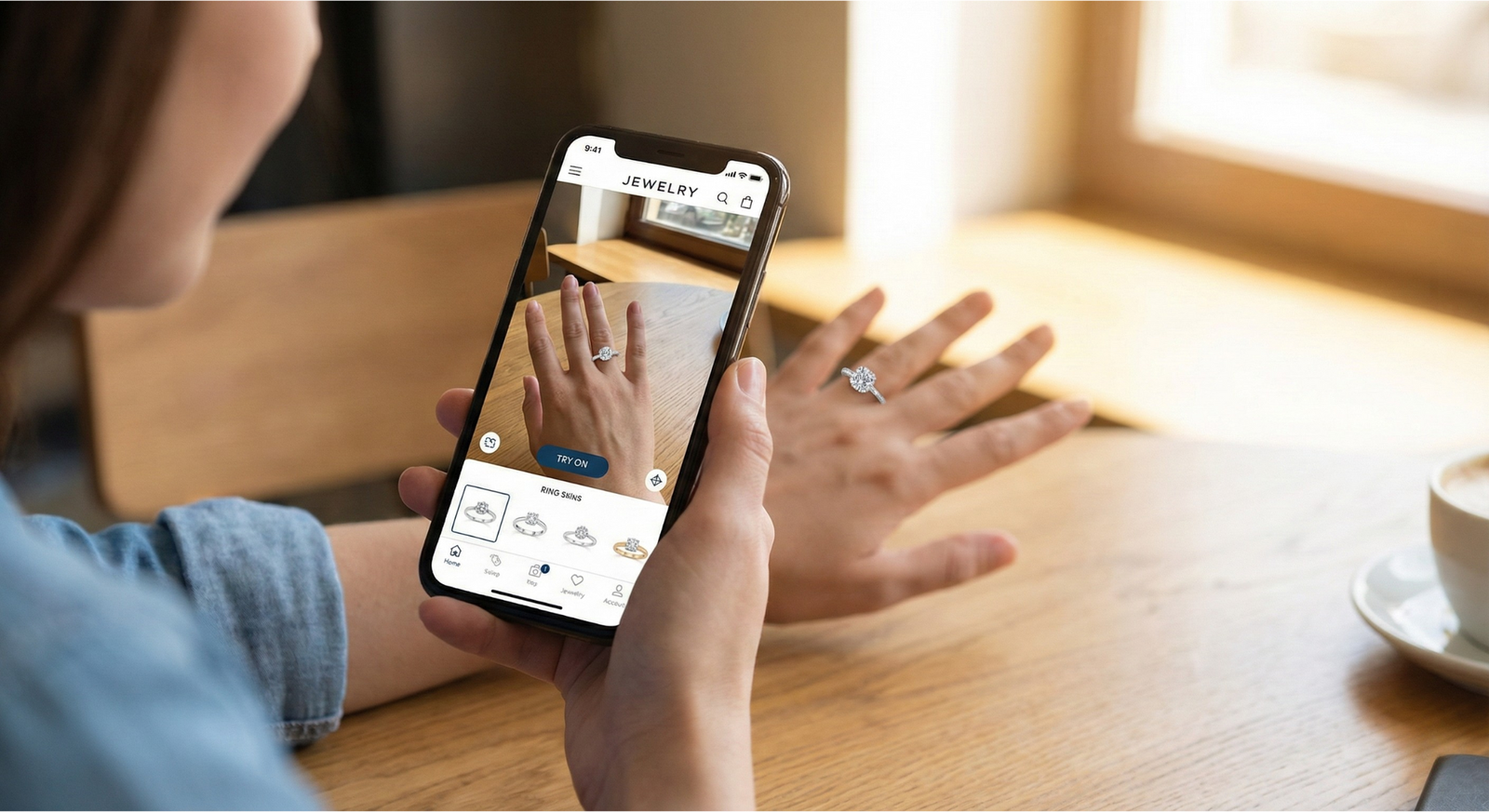
Septum Rings Virtual Try On RFP
If your team is evaluating augmented reality vendors, a septum rings virtual try on rfp is the single best way to ensure proposals meet the precise technical and business needs of nasal jewelry. This guide explains why septum-specific requirements matter, what to include in a downloadable virtual try on rfp template, and how to score vendor responses so you can move from procurement to live testing quickly.
Download the editable septum rings virtual try on rfp template (DOCX / Google Doc / PDF) — email-gated: https://cermin.id/blue-light-glasses-virtual-rfp
Quick Summary
- Septum try-ons require specific landmarking and depth (Z-axis) control for realistic results.
- Include KPIs, acceptance criteria, and a scoring matrix to objectively compare vendors.
- Choose between zero-code link-based for speed or SDK/API for complete control.
- Use templates that cover scope, technical aspects, pricing, analytics integration (GA4), and QA checklists.
Why you need a dedicated RFP for septum ring virtual try-on
Why a septum rings virtual try on rfp matters
- Septum placement is geometrically sensitive: small offsets make a ring look off-center or float above the nose. See AR jewellery fit challenges for details.
- Piercing-style filters show strong engagement but require different landmarking and rendering approaches than standard jewelry overlays: piercing filter research.
- Nose-specific filters (placement and blend) demonstrate how lighting and proximity affect realism: nose-piercing filter example.
From a procurement perspective, a targeted RFP avoids generic AR proposals that under-spec the fit/landmarking, skin tone handling, and channel deployment you need. A focused RFP clarifies acceptance criteria, measurement, timelines, and privacy controls so vendor responses are comparable and actionable. See a vendor example.
Unique technical & UX requirements for septum rings
Procurement checklist — must-have feature list
- Accurate facial landmarking for nasal anatomy (septum and nostril reference points). Source: AR jewellery fit guidance.
- Dynamic offset and depth (Z-axis) control per SKU for realistic sit and shadowing.
- Multi-angle validation: profile, three-quarter, and frontal views.
- Tone-aware rendering: support for Fitzpatrick I–VI skin tones and adaptive metal reflections. See rendering accuracy note: tone-aware rendering reference.
- Lighting adaptation and specular highlights for metal finishes.
- Low-latency tracking and <2s load times (performance targets in QA section).
- Shareable link deployment for web, mobile, and social (no SDK) and pixel/analytics support. Deployment options.
Business outcomes to justify procurement
- Engagement lift: piercing and filter examples show strong on-platform engagement; use these as benchmarks (CyberLink filter insights).
- Conversion and return impacts: AR jewellery use cases and vendor case studies suggest measurable conversion and return improvements; include conversion/return targets and require baseline comparisons. See AR jewellery overview: AR jewellery overview and a virtual jewellery tool example: virtual jewellery tool. Also reference: ROI guidance.
- Note: If you request specific percentage improvements, require vendors to back numbers with references or past case studies (mark speculative targets as such in the evaluation matrix).
What the downloadable septum rings virtual try on rfp template includes
virtual try on rfp template — itemized contents
- Project overview and objectives (brand, product lines, desired channels).
- Technical requirements and optional integrations (link-based vs SDK/API).
- Creative asset specifications (2D/3D source files, naming conventions).
- Scope of work and deliverables (per-SKU link, QA, pilot).
- KPIs with formulas and reporting cadence (plug-and-play metrics).
- Timeline & milestones (editable Gantt rows for zero-code and SDK options).
- Acceptance criteria, device matrix, and QA checklist.
- Pricing request format (per-SKU, SaaS, CPM, rev-share).
- Vendor scoring matrix and sample scoring sheet.
- Filled sample try on proposal template (tryitonme example) and one-page procurement checklist.
Download the template here: https://cermin.id/blue-light-glasses-virtual-rfp
Scope of work — sample items to include
Sample scope items for your try on proposal template
- Catalog size: define initial and scale SKUs (e.g., 50 / 100 / 500 SKUs).
- Variants: gauge sizes (16G–14G), finishes (gold, silver, rose), hoop vs. captive bead.
- Asset type: specify whether vendor will create 2D overlays or full 3D models and acceptable file formats.
- Fit validation: require per-SKU fit testing across nose types and skin tones.
- Channels: list PDP, mobile app, Instagram/TikTok links, paid ad creative URLs, and messaging channels (SMS/WhatsApp). Channel integration example.
- Integrations: GA4 events, commerce hooks (Shopify/WooCommerce), CDN requirements.
- Support & SLA: response times, bug triage, update cadence.
Product & catalog specifics (SKUs, variants, naming)
SKU metadata checklist
- SKU ID, title, size/gauge, finish, weight, product images (front/side), 3D file (if available).
- Naming convention: BRAND_SKU_GAUGE_FINISH (example).
- Variant mapping: allow SKU-level tunables for offset and depth.
AR accuracy & fit validation requirements
Validation checklist
- Fit success rate target (ask vendors to commit to a validation method and results).
- Test set requirement: require vendors to run accuracy tests across a representative set of noses and skin tones (Fitzpatrick I–VI).
- Define acceptable tolerance thresholds (e.g., visual offset tolerance in pixels or mm — request vendor measurement method).
- Lighting and pose matrix: frontal, three-quarter, profile, smiling, and tilt tests.
Technical requirements & deployment options
Comparing deployment paths: link-based vs SDK/API
Zero-code Link-Based (fast-to-market)
Minimal engineering, per-product shareable links, works across web, mobile, and social — ideal for marketing/paid channels.
SDK/API Integration (custom)
Deeper control and embedded experiences but requires engineering time and platform-specific builds. For background on AR jewellery technical strategies, see: AR jewellery technical strategies and an example virtual jewellery tool: virtual jewellery tool example.
Option A — Zero-code link-based (tryitonme.com option)
Zero-code onboarding (exact steps)
- Purchase a 6-month package based on SKU count.
- Send standard product photos (e.g., front/side for eyewear — apply same logic for septum imagery).
- tryitonme team/AI handles AR processing and asset generation.
- Receive unique, ready-to-use try-on link for deployment in under 3 business days (for link creation/initial QA). Confirm with product/legal teams: product page and sample/demo: demo / sample.
Benefits: ZERO-CODE, link-based deployment; fast time-to-market; works in any browser, social post, or ad.
Option B — SDK/API integration
Pros and cons
- Pros: Full custom UI/UX control, deeper personalization, potential offline capabilities.
- Cons: Higher engineering cost and longer timelines; platform-specific maintenance. Typical integration durations referenced in AR guidance: integration guidance.
Required integrations & security/privacy must-haves
Security & integration checklist
- GA4 events and commerce hooks (tryon_initiated, tryon_completed, add_to_cart_from_tryon). Analytics example.
- CDN for asset delivery, pixel tracking support.
- Encryption in transit, documented data retention and deletion policy, GDPR compliance: GDPR guide.
- Audit logs and SLA for uptime/incident response.
KPIs and measurement framework (what to ask for in the RFP)
virtual try on rfp template — KPI copy to paste
- Try-on rate = (Try-on opens / Product page visits) x 100 — request vendor baseline and aim for improvements informed by piercing/filter engagement examples: piercing filter.
- Conversion lift = (CR_with_VTO / CR_baseline) – 1 — require monthly A/B or matched-cohort reporting.
- AOV lift = (AOV_VTO_users / AOV_baseline) – 1 — request sample cohort analysis.
- Return rate delta = (Return_rate_VTO – Return_rate_baseline) — request historical benchmarks or treat as a target to monitor.
- Engagement metrics: time_in_tryon, share_rate, # of product views per session.
- Performance: load_time_avg (<2s desired), error_rate (<1%).
For AR KPI context see: AR jewellery KPI guidance.
Example KPI definitions & reporting cadence
- Try-on rate — Try-ons / PDP visits — vendor to propose baseline & target — Weekly
- Conversion lift — (CR_with_VTO / CR_baseline) – 1 — +10–30% (ask vendor to justify) — Monthly
- Return rate delta — % returns VTO vs baseline — -5–15% reduction (set as goal) — Monthly
Timeline & milestones (to include in template)
Two editable sample timelines
Zero-code link-based (tryitonme sample, total 3–5 weeks)
- Discovery & scope: 1 week
- Asset prep: 1–2 weeks
- Link creation & QA: under 3 business days per batch
- Pilot & optimization: 2 weeks
- Launch
SDK/API integration (sample: 9–16+ weeks)
- Discovery: 1–2 weeks
- Integration & development: 4–8 weeks
- QA: 2 weeks
- Pilot: 2–4 weeks
Reference: AR jewellery project considerations: project considerations.
Acceptance criteria, testing & QA checklist
QA checklist to paste into the RFP
- Device/browser matrix: iOS Safari/Chrome, Android Chrome, desktop Chrome/Edge — require 95% pass on core flows.
- Accuracy: vendor must demonstrate >90% fit accuracy on a defined test set (report methodology).
- Performance: load <2s, stable 30–60fps tracking.
- Analytics: events validated in GA4; dashboard access during pilot.
- UAT: 20-user acceptance test with defined pass/fail criteria and rollback plan.
Pricing & commercial model guidance
Pricing scenarios to request
- Per-SKU setup + per-link usage fee (e.g., request vendor tiers).
- SaaS subscription (monthly/annual).
- CPM for campaign-delivered links.
- Rev-share models for marketplaces.
Ask vendors for pilot pricing, scale tiers, and any engineering or customization fees. Pricing guidance.
Vendor evaluation & scoring matrix (include template fields)
Scoring rubric (sample weights)
- Technical fit (25) — AR accuracy for septum
- Time-to-launch (20)
- Cost (15)
- Privacy/SLA (15)
- References & case studies (15)
- Customizability (10)
Provide a 1–10 scoring scale and require supporting evidence for scores above 7.
Sample RFP questions to include (detailed list)
Paste-ready vendor questions
Technical
- Describe your septum placement algorithm (landmarks, offsets, validation method). Reference: AR jewellery fit guidance.
- Do you support link-based (no-code) deployment and per-SKU links?
UX
- Which post-try CTAs are supported (add-to-cart, share, save)?
Analytics
- Provide the GA4 event schema and sample dashboard.
Security
- Describe face data handling, retention, encryption, and GDPR compliance: GDPR guide.
Support & SLA
- SLA response times, escalation procedures, training materials.
References
- Provide 2–3 jewelry/septum pilot references and KPI outcomes.
Example filled-out try on proposal template (tryitonme.com case study)
try on proposal template — sample (copy-ready)
- Vendor: tryitonme.com
- Scope: 100 septum SKUs, per-SKU link-based VTO
- Timeline: 4 weeks total (discovery → pilot → launch)
- KPIs: example targets (try-on rate 25%, conversion lift +15% — vendors must substantiate these in proposals)
- Deployment: no-code links for PDP, social, ads; GA4 integrated
- Pricing (example): $2k setup + $1k/mo (example case; confirm with vendor)
- Notes: Request a live sample septum link and pilot terms: sample and demo
Next steps & CTA
- Download the free virtual try on rfp template & try on proposal template (email-gated): download template
- Request a live septum ring sample link: https://tryitonme.com/sample
- Book a demo to walk through the filled proposal and pilot options: book demo
Why tryitonme.com is the Right Fit for Your Business
- Accessory-focused AR accuracy for rings, earrings, and septum: tailored landmarking and depth controls.
- Speed: zero-code, link-based deployment to web, social, and ads with fast link delivery.
- Easy integration: works with existing PDPs and analytics (GA4, commerce hooks).
- Scalable per-SKU approach for catalogs and campaigns.
Book a Demo: https://tryitonme.com/demo
Appendix / Assets to include with the post
Downloadable assets (included with template)
- DOCX, Google Doc, and PDF RFP templates
- One-page procurement checklist
- Filled try on proposal template (tryitonme example)
- Timeline infographic and KPI dashboard mock-up
- GDPR guidance link: https://gdpr.eu/
FAQ
What does the septum rings virtual try on rfp template include?
Full scope, technical specs, KPIs, scoring matrix, and a filled vendor example.
Why is a septum-specific RFP necessary?
Septum rings require dedicated landmarking, depth, and lighting handling—general jewelry VTO specs often miss these details. See AR jewellery fit guidance: AR jewellery fit & challenges.
How fast can a no-code solution go live?
Link-based deployments are designed for rapid rollout (see tryitonme’s zero-code process): https://tryitonme.com/product. Confirm exact SLA with vendor.
What KPIs should procurement demand?
Try-on rate, conversion lift, AOV lift, return-rate delta, engagement metrics and performance (load time/error rate). Reference KPI guidance in the template and AR KPI context: AR KPI guidance.
Is GDPR covered?
Include data retention, encryption, and processing location requirements in the RFP and reference GDPR best-practices: https://gdpr.eu/.
Production & SEO checklist (editor)
- Ensure the primary keyword “septum rings virtual try on rfp” appears in H1, the first paragraph, and at least one H2.
- Include “virtual try on rfp template” and “try on proposal template” in at least one H2 and CTA buttons.
- Link to external research when specific claims or technical guidance are cited:
Final note: This guide and the attached templates are built to help procurement teams evaluate vendors on a level playing field and accelerate time-to-pilot. For product-specific claims (turnaround times, pricing examples, SLA commitments), confirm details directly with tryitonme.com product and legal teams via: https://tryitonme.com/product or request a live sample link at https://tryitonme.com/sample.