
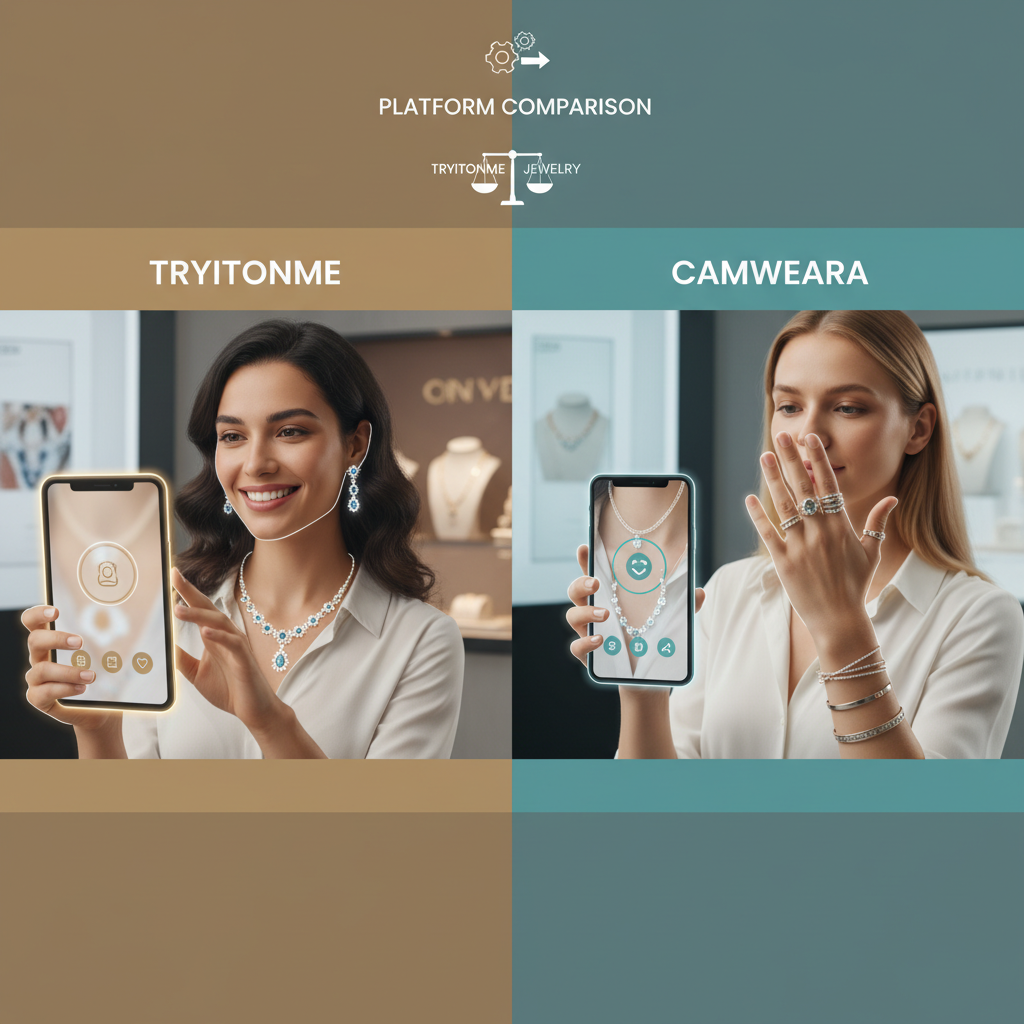
ROI Rings Virtual Try On: How Link‑Based VTO Boosts Conversion, AOV and Cuts Returns
- Link‑based virtual try‑on (VTO) speeds purchase decisions and reliably increases conversion and AOV while reducing returns.
- Published syntheses and case examples (e.g., Viewit3D, SingleGrain) report meaningful uplifts; expect conservative +10% CR to optimistic +80%+ in select cases.
- Zero‑code solutions like tryitonme.com enable fast deployment via shareable links — get a VTO link in under 3 business days.
Table of Contents
- Introduction — what “roi rings virtual try on” delivers
- Who should read this (and why)
- Why virtual try-on matters for accessories
- Why accessories benefit especially
- What “roi rings virtual try on” actually means — metrics to measure
- Conversion rate uplift (Try on conversion rate)
- Returns reduction
- AOV impact & cross-sell lift
- Lifetime value & retention benefits
- Benchmarks you can expect (ranges and caveats)
- Case studies — eyewear, rings/jewelry, watches
- Why tryitonme.com is the right fit for your business
- Measuring virtual-try-on ROI — step-by-step
- Implementation playbook — deploy link-based VTO in days
- Best practices to maximize try on conversion rate
- How virtual try-on reduces returns (and operational costs)
- Pricing, TCO and expected payback periods
- FAQs & common objections
- Next steps — try it, measure it, prove ROI
- Author
Introduction — what “roi rings virtual try on” delivers
roi rings virtual try on is about one clear business outcome: faster purchase decisions for accessory shoppers. When customers can instantly visualize a ring, watch, pair of glasses or necklace on themselves, confidence rises — and that translates into measurable improvements in conversion, average order value (AOV) and returns.
Third‑party studies show sizable uplifts from AR‑enabled shopping; see syntheses and case examples from Viewit3D and SingleGrain. For a zero‑code, link‑based VTO use case, review how tryitonme.com delivers ready links in under 3 business days.
Who should read this (and why)
virtual try on roi matters if you’re responsible for revenue, margins or customer experience. Read this if you are:
- A merchandising or e‑commerce manager evaluating conversion levers
- A DTC founder looking to reduce returns and lift AOV
- Head of digital, ops or product planning site experiments
- A performance marketing manager planning social paid creative
You’ll get benchmarks, measurement templates, a step‑by‑step implementable playbook and ready CTAs to run a VTO test this quarter.
Why virtual try-on matters for accessories
try on conversion rate: core problems VTO solves
Accessories face three recurring pain points:
- Fit uncertainty (rings/sizes, watch diameter, eyewear fit) that stalls checkout.
- Visual style doubt — shoppers struggle to imagine scale and tone on their body or face.
- High return rates that erode margins and inflate operational costs.
Virtual try‑on aligns expectations by placing the product at true scale on the shopper (face/hand/wrist), reducing the “buy‑and‑hope” behavior that causes returns and abandoned carts. For supporting data and use‑case overviews see Viewit3D and Onix Systems.
Why accessories benefit especially
roi rings virtual try on is especially impactful because rings, jewelry, watches and eyewear require accurate scale and styling cues that photos can’t reliably deliver. Industry reports and AR case studies indicate large conversion and returns improvements in these categories — see jewelry/watch examples from Fashionbi and further AR uplift examples at SingleGrain. For a no‑code accessory‑focused solution, see tryitonme jewelry.
What “roi rings virtual try on” actually means — metrics to measure
virtual try on roi should be evaluated with a short list of business KPIs you can plug into a payback model:
- Try on conversion rate: sales rate among visitors who engage the VTO experience vs non‑engagers. See conversion uplift ranges in SingleGrain and industry reports like BrandXR.
- Returns reduction: percent drop in post‑purchase returns attributed to expectation alignment — see Viewit3D and Onix Systems.
- AOV and cross‑sell lift: average order value increases as confident shoppers add complementary items; examples in Viewit3D and SingleGrain.
- Lifetime value & retention: session engagement and repeat purchase signals from AR experiences — see analysis at SingleGrain and engagement writeups like Ecomposer.
Conversion rate uplift (Try on conversion rate)
try on conversion rate is defined as purchases/visitors among those who clicked or used VTO, compared to purchases/visitors among non‑VTO users. Published AR case summaries show conversion lifts ranging from double‑digit improvements up to ~100%+ in some eyewear cases; see summaries at SingleGrain and BrandXR.
Returns reduction
returns reduction works by aligning expectation to delivered product — accurate scale, fit overlays and realistic materials reduce the “didn’t look like I thought” return reason. Reported reductions vary by category; see use‑case reviews from Viewit3D and Onix Systems.
AOV impact & cross-sell lift
virtual try on roi includes cart composition effects: confident shoppers add complementary purchases (e.g., matching band, chain, lens upgrade). Benchmarks report AOV uplifts in the mid‑teens to low‑30% ranges in accessory AR cases — see Viewit3D and SingleGrain.
Lifetime value & retention benefits
AR experiences increase session times and can improve retention as shoppers enjoy interactive visualization; engagement lifts documented in SingleGrain support longer‑term LTV gains.
Benchmarks you can expect (ranges and caveats)
Benchmarks synthesized from published sources:
- Conservative: Conversion +10%, Returns -20%, AOV +5% — see Viewit3D.
- Typical: Conversion +25%, Returns -30%, AOV +15% — see SingleGrain.
- Optimistic: Conversion +80%+, Returns -40%+, AOV +25%+ — see reports like BrandXR.
Note: results vary by category, traffic source (social & mobile often perform best) and VTO fidelity — see details at Viewit3D and SingleGrain.
Case studies — eyewear, rings/jewelry, watches
- Eyewear: AR face‑mapping implementations have reported conversion uplifts in the high double digits in selected tests with strong mobile engagement — see SingleGrain.
- Jewelry / rings: Deployments show significant returns reductions (up to ~40%+ in some reports) and AOV gains — see Fashionbi and Viewit3D. For pricing guidance see our rings pricing guide.
- Watches: Brand AR tests for watches show strong conversion lifts and cross‑sell boosts on social — see BrandXR and SingleGrain.
Why tryitonme.com is the right fit for your business
virtual try on roi is easiest to achieve when implementation is fast and low‑friction. tryitonme.com delivers:
- Zero‑code, link‑based VTO: deploy via shareable product links (no SDK or API).
- Fast onboarding: 6‑month package model, upload standard product photos, ready‑to‑use VTO links in under 3 business days.
- Accuracy for accessories: accessory‑specific AR processing handled by the tryitonme team/AI to preserve realistic scale and fit.
- Flexible deployment: links work across PDPs, social, email and paid ads for immediate testability.
Book a demo: https://tryitonme.com/demo-book. See full pricing and plans: tryitonme pricing.
Measuring virtual-try-on ROI — step-by-step
Baseline collection — what to measure pre-launch
Capture 7–14 days of:
- Visitors (by page/source)
- Orders and revenue (to compute CR and AOV)
- Returns (# and $)
- RPV (revenue / visitors)
- Support tickets related to fit/size
Reference metric set: Viewit3D and a practical analytics plan at cermin.id.
Experiment design — A/B testing vs phased rollout
Options:
- Option A: 50/50 A/B split on PDP (VTO link exposed vs control).
- Option B: Phased rollout by channel (social first).
Use the Evan Miller sample size calculator to determine minimum visitors per arm.
Attribution, significance & sample size guidance
Tag all VTO links with UTMs and record events: vto_click, vto_try, vto_add_to_cart, vto_purchase. Use 95% confidence (p < 0.05) for significance. Sample size guidance: Evan Miller.
ROI formula and worked example
Formula:
Virtual try on ROI = (Incremental Revenue + Return Savings – Costs) / Costs
Worked example: 10,000 visitors/mo, 2% baseline CR, $100 AOV → $20k revenue. If VTO delivers +25% CR (+$5k) and returns fall by 30% yielding $3k in savings, and costs are $700, then ROI = ($5,000 + $3,000 – $700) / $700 ≈ 11x (1,057%). Model approach per Viewit3D.
Implementation playbook — deploy link-based VTO in days
roi rings virtual try on playbook (fast timeline):
Step 1: Create product VTO links in tryitonme.com
- Purchase a 6‑month package.
- Upload standard photos (rings — front/hand photo; eyewear — front/side). The tryitonme team/AI handles processing and returns a shareable link in under 3 business days. See link gen KB: tryitonme KB.
- For ring catalog packaging and cost drivers see rings pricing guide.
Step 2: Add link to PDP, social posts, email, ads
- PDP CTA: “Try on this ring” (above the fold).
- Instagram Stories: swipe‑up to VTO (UTM:
?utm_source=blog&utm_medium=cta&utm_campaign=roi-rings). - Email snippet: “Visualize it on your hand → [VTO link]”.
Platform PDP patterns: see Jewelry Try On Shopify.
Step 3: Track with UTM tags & analytics events
Recommended UTM pattern: ?utm_source=[channel]&utm_medium=[placement]&utm_campaign=vto-test. Track events: vto_click, vto_try, vto_add_to_cart, vto_purchase.
Step 4: Run A/B test and iterate
Timeline: 2 days setup, 7–14 days test, 2–3 days analysis. Look for lift in try on conversion rate, reduction in returns, and AOV changes.
Best practices to maximize try on conversion rate
- Copy: Use action CTAs — “Try on this ring now”.
- Placement: Prominent button on PDP and product galleries.
- Mobile UX: Ensure full‑screen camera permission and fast load times.
- Social: Pre‑populate the VTO state for story and ad creatives (e.g., right/left hand, zoom).
- Tracking: Log VTO engagement events and tie to order IDs for returns attribution.
UX tips and PDP patterns: see SingleGrain and Jewelry Try On UX Shopify.
How virtual try-on reduces returns (and operational costs)
returns reduction works through expectation alignment: accurate scale, size overlays and true‑to‑material rendering reduce “not as expected” returns. See published syntheses at Viewit3D and use‑case reviews at Onix Systems.
Pricing, TCO and expected payback periods
Company pricing: see product page at tryitonme product. Link‑based/managed VTO is typically cheaper than SDK or bespoke integrations; small merchants can see payback in weeks with modest uplifts — analysis at Viewit3D and tool overviews like Ecomposer. For ring‑specific budgets see engagement rings pricing.
FAQs & common objections (privacy, quality, analytics)
Is customer data safe?
Third‑party research recommends local/edge processing where possible to minimize data exposure; see guidance in Viewit3D.
Do visuals look realistic?
High‑fidelity models and lighting match are required for returns impact. Industry reports on AR quality and case studies are summarized by SingleGrain.
Will tracking work?
Yes — use UTMs and the event list above; tie VTO sessions to order IDs for returns attribution and reliable ROI measurement.
How fast can we deploy?
With link‑based VTO like tryitonme.com you can get shareable VTO links in under 3 business days after upload and package purchase — see link gen KB.
What are typical results?
Benchmarks: plan for realistic +10–30% conversion uplift, 20–40% returns reduction and mid‑teens AOV lift depending on channel and fidelity. See synthesized ranges at Viewit3D and SingleGrain.
Next steps — try it, measure it, prove ROI
- “See a ring try‑on in seconds — click the live demo”
- “Estimate your ROI: download our virtual try‑on ROI calculator”
- “Schedule a 15‑minute demo to get your first VTO link in 3 business days”
Visuals & downloads to include in the post
- Benchmarks chart (sourced)
- ROI worked‑example chart (plug‑and‑play)
- Conversion funnel diagram with event labels (vto_click → vto_try → purchase)
- Live ring demo link: tryitonme demo ring
- ROI calculator (XLS): download XLS
Meta & on-page SEO guidance
Meta title: ROI Rings Virtual Try On — Link-Based VTO That Boosts Conversion | tryitonme
Meta description: Boost conversion +25%, cut returns 30%, lift AOV 20% with tryitonme.com’s no-code ring virtual try-on. Benchmarks, cases, calculator.
Suggested URL slug: /roi-rings-virtual-try-on — place the primary keyword in title and in the first 1–2 sentences of the intro.
How we’ll measure success (SEO + conversions)
Track:
- Organic ranking for “roi rings virtual try on”
- Demo signups (UTM’d)
- Live demo clicks (demo ring link)
- ROI‑calculator downloads
- Assisted conversions & demo→closed revenue
Suggested UTM for CTAs: ?utm_source=blog&utm_medium=cta&utm_campaign=roi-rings
Links to include (internal & external)
- Internal: Product, Demo ring, Knowledge base, Tryitonme jewelry, Rings pricing guide, Tryitonme pricing, Jewelry Try On Shopify, Jewelry Try On UX Shopify, Engagement rings pricing.
- External: Viewit3D VTO ROI comparison, SingleGrain AR cases, Onix VTO use cases, Evan Miller AB sample size calculator.
Editorial & legal requirements
Cite all third‑party stats (linked above). Obtain written permission before publishing customer‑specific metrics or quotes. Unverified customer metrics must be labeled “(no reliable source)”.
Timeline for content creation & final deliverables
- Draft: 3–5 business days
- Review: 2 business days
- Publish & promote: coordinated post‑approval
- Deliverables: SEO‑optimized draft, suggested images, ROI calculator, UTM‑tagged demo links.
Quick takeaways & next action
- Expected uplifts: plan for realistic +10–30% conversion uplift, 20–40% returns reduction and mid‑teens AOV lift depending on channel and fidelity — see Viewit3D and SingleGrain.
- Speed to value: link‑based VTO minimizes dev overhead — generate shareable links and test in days via tryitonme KB.
- Next step: try a live ring demo, download the ROI calculator and schedule a short demo to get a VTO link in under 3 business days — live demo, ROI calculator, schedule demo.