
Bangles Virtual Try On Pricing
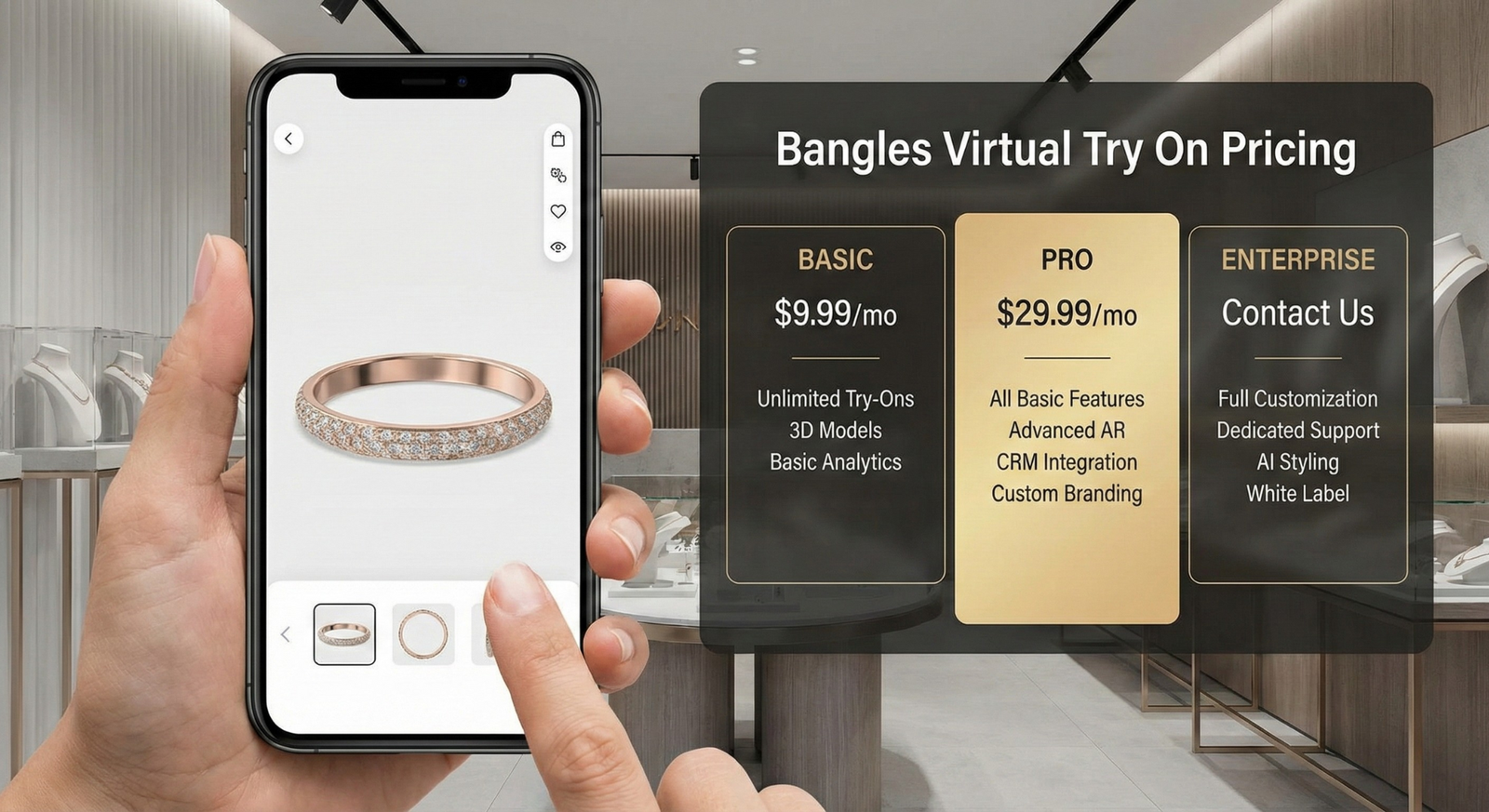
Quick Summary
- VTO pricing for wristbands depends on the number of SKUs, level of realism (2D vs. 3D/PBR), and material complexity.
- Link-based/no-code models like tryitonme.com reduce integration costs and speed up launch.
- Per-SKU modeling typically has a one-time cost; hosting, analytics, and SLAs add recurring costs.
- Estimated plans: Starter ($0–$199/mo), Growth ($200–$1,000/mo), Pro ($1,000–$5,000/mo), Enterprise ($5k+/mo).
Introduction
Bangles virtual try on pricing is the single most common question we hear from jewelry brands evaluating AR/AI try‑on. Bangles virtual try on pricing matters whether you manage a boutique catalog of 50 SKUs or an enterprise with thousands—so it’s worth understanding the drivers, common packages, and realistic budget ranges.
tryitonme.com is a zero‑code, link‑based VTO that deploys via shareable product links (no SDK/API required) and can deliver a working try‑on link in under 3 business days—making fast launches practical for e‑commerce teams. See the Tryitonme Shopify app listing and book a demo.
Quick intro — what this post will help you decide
This post explains virtual try on pricing and helps you pick the right virtual try on packages for bangles—balancing realism, speed, and total cost of ownership. You’ll learn the product‑specific factors that raise or lower the cost of bangles try on, the typical commercial pricing models you’ll encounter, sample budget ranges (labeled estimates), and a short implementation checklist so you can get from quote to live link quickly. For a practical vendor that eliminates SDK work, see tryitonme’s Shopify listing.
Why bangles VTO is different (product-specific considerations)
Bangles aren’t the same as earrings or rings. Their circular geometry requires accurate wrist detection, curvature matching, and collision handling so the bracelet sits correctly as the customer moves. Metal finishes and gemstones introduce complex reflections and micro‑shading needs, and realistic size/fit across different wrist shapes means you may need resizing algorithms or multiple model variants. Industry notes on jewellery AR discuss these challenges and why they affect cost: see Banuba’s overview of jewelry VTO (Banuba — Virtual Try‑On Jewelry) and PRMal’s coverage of customer expectations (PRMal — Virtual Try‑On). tryitonme’s approach simplifies deployment via link‑based delivery (tryitonme Shopify app).
2D overlay vs full 3D/PBR tradeoff
A 2D overlay or template‑mapped approach is fast and cheap but can look flat on complex surfaces. Full 3D mesh models with PBR (physically based rendering) materials handle lighting, reflections, and proper occlusion—giving photoreal results at higher modeling and rendering cost. The choice directly affects per‑SKU modeling effort, runtime performance on devices, and therefore virtual try on pricing.
Key factors that drive virtual try on pricing
Below is a practical checklist of the inputs that will move your cost lines. Each item affects development, modeling, or ongoing fees.
- Number of SKUs to enable — Per‑SKU modeling is common; bulk discounts are typical as SKU count grows. See typical try‑on app packaging: tryitonme Shopify listing. For bracelet‑specific pricing guidance, see a practical guide: bracelets pricing guide.
- Level of realism needed (overlay → photoreal 3D & PBR) — Higher realism increases per‑SKU modeling time and rendering costs; see an industry overview: Glamar — Best Augmented Reality Jewellery.
- Type of modeling required (2D templates, 3D scanning, photogrammetry) — 2D templates are fast; photogrammetry/3D scanning yields better fidelity but is costlier. Banuba outlines these approaches: Banuba — Virtual Try‑On Jewelry.
- Materials & finish complexity — Multi‑material objects and gems need more PBR work and lighting tests.
- Size/fit variation handling — Automated resizing or size‑specific models adds development and QA time.
- Interaction & UI features — Zoom, rotate, stacking, and social share links increase front‑end work and pricing tiers.
- Integrations & channels — Link‑based solutions reduce channel‑specific integration costs; see tryitonme’s link approach: tryitonme Shopify app and Shopify guidance: jewelry try‑on Shopify.
- Analytics, A/B testing, and reporting — Built‑in dashboards usually appear in higher‑priced tiers.
- SLA, uptime, and enterprise security needs — Dedicated SLAs, SSO, or enhanced security increase enterprise costs.
- Ongoing maintenance, model updates, seasonal refreshes — Distinguish one‑time modeling fees from recurring hosting/maintenance.
- Time to implement / turnaround — Accelerated delivery (rush fees) affects price.
Common pricing models & virtual try on packages to expect
Vendors use several commercial structures—pick the one that fits your catalog and traffic profile.
- Pay‑per‑SKU (one‑time modeling + hosting) — One‑time modeling charge per item, plus hosting/subscription for link delivery and analytics. Market examples: Banuba.
- Per‑link / per‑try (usage‑based) — Cost scales with try‑on sessions—good for seasonal or low‑volume offerings.
- Subscription tiers (starter → enterprise) — Monthly plans bundle SKUs, usage, and features. See an example: tryitonme Shopify listing and a pricing map: tryitonme pricing for accessories.
- One‑time setup vs recurring — Expect upfront setup/modeling fees plus ongoing subscription or per‑try charges.
- Revenue‑sharing (rare) — Some vendors offer revenue‑share models tied to conversion uplift.
tryitonme.com’s link‑based zero‑code model simplifies pricing by removing integration and SDK costs; it maps cleanly into subscription tiers and per‑SKU modeling where needed: tryitonme Shopify app.
Example price ranges and sample packages (estimates)
Below are labeled estimates to help you budget—actual prices vary by vendor and project scope.
- Starter / Trial: $0–$199/mo — basic overlays, shareable links, limited SKUs. Ideal for small catalogs and trials. (estimate) — reference: tryitonme app
- Growth: $200–$1,000/mo — analytics, modest 3D, faster SLAs, 100–500 SKUs. (estimate) — reference: tryitonme app
- Pro: $1,000–$5,000/mo — photoreal 3D, custom UI, multi‑channel support, 500+ SKUs. (estimate) — reference: Glamar overview
- Enterprise: $5k+/mo + one‑time modeling/setup fees — full custom integrations, dedicated support. (estimate) — reference: tryitonme app
Per-SKU modeling (estimates)
Why tryitonme.com is the Right Fit for Your Business
If you need a fast, low‑overhead path to bangles VTO, tryitonme.com is designed for commerce teams:
- Zero‑code, link‑based deployment — no SDK/API work required; shareable links work across web, mobile, and social. (See: tryitonme Shopify app)
- Speed: typical turnaround to receive your ready‑to‑deploy try‑on link is under 3 business days after onboarding.
- Accuracy for accessories: specialist processing for eyewear, jewelry, watches, and hats—accessory‑focused workflows reduce modeling rework. (See: tryitonme Shopify app)
- Lower TCO: eliminates developer/QA hours and reduces integration complexity—faster ROI and fewer hidden costs.
- Flexible packages: from trial tiers to enterprise support and per‑SKU modeling options. (See demo and pricing: tryitonme demo and tryitonme pricing)
Side-by-side cost comparison — custom SDK/API integration vs link-based no-code VTO
What you pay for is more than software—hidden costs add up.
- Dev hours & integration
- SDK/API: significant developer time for integration, platform QA, and updates. Estimates commonly cited: 100–500+ dev hours. See Banuba for SDK approaches: Banuba.
- Link‑based: no dev hours—deploy via shareable link: tryitonme Shopify app.
- Timeline
- SDK/API: 6–12+ weeks (integration, testing).
- Link‑based: days to a week (setup and model processing).
- Maintenance & updates
- SDK/API: ongoing maintenance and platform compat fixes.
- Link‑based: vendor‑managed hosting and updates—lower internal IT overhead.
- Example TCO (estimates)
- SDK/API approach could add $10k–$50k in integration cost (one‑time) plus monthly maintenance.
- Link‑based subscriptions often start from low monthly fees (see tryitonme tiers: tryitonme Shopify app).
How to calculate ROI and whether the investment is worth it
Track these key metrics: conversion uplift, average order value (AOV), returns reduction, engagement time, and try‑to‑buy conversion. Industry overviews suggest meaningful uplifts for jewelry AR—see examples: Glamar — Best Augmented Reality Jewellery.
Example ROI (estimate)
Scenario: $500/mo VTO subscription; your product page gets 1,000 monthly visitors. If VTO drives a conservative 5% relative conversion uplift and average order value rises by $50, incremental monthly revenue could be: 1,000 visitors × baseline conv rate × 5% uplift × $50 AOV = (varies by baseline conv). With modest traffic and uplift, many brands recoup VTO costs within weeks to a few months. Faster launches (link‑based) reduce upfront dev spend, shortening payback further. (Illustrative/estimates; see Glamar for uplift context.)
Implementation checklist & timeline (what to expect during setup)
What we’ll ask for
- High‑quality product photos (front/side/top) or existing 3D files.
- SKU list, material/finish notes, and any size/fit variants.
- Brand assets for UI (logo, colors) if customization is needed. For UX patterns and PDP best practices when adding jewelry try‑on to Shopify, see: jewelry try‑on UX for Shopify.
Estimated timeline (estimates)
- Link‑based basic setup: often days—ready‑to‑deploy link in under 3 business days (tryitonme onboarding).
- Photoreal 3D creation: 1–4 weeks (per complexity).
- Enterprise integrations: 6–12+ weeks.
Suggested 3-step flow for fast launches
- Send photos/SKU list
- AR team models & QA
- Receive shareable try‑on links and embed instructions
Start a demo or request pricing
Book a demo: https://tryitonme.com/demo — Get a quote for X bangles: https://tryitonme.com/pricing.
FAQs — quick commercial answers
- How much does it cost to add 100 bangles to a VTO tool?
- Estimate: $2k–$10k one‑time modeling + $20–$200/mo subscription, depending on realism and features; bulk discounts are common. (Estimates) See tryitonme app and modeling notes: Banuba.
- Is there a free trial or pay‑as‑you‑go option?
- Many vendors offer trials and pay‑as‑you‑go tiers—tryitonme provides demo and trial options: tryitonme demo.
- What increases the cost of bangles try on the most?
- SKU count, high photorealism (photogrammetry/3D scanning), complex materials/gemstones, and custom integrations or enterprise SLAs drive cost highest.
- Do I need custom development to use VTO on social channels?
- No—link‑based solutions like tryitonme deploy across social without channel‑specific SDKs: tryitonme Shopify app.
- How long does it take to get a working try‑on link?
- Link‑based setups typically deliver a working try‑on link in under 3 business days for basic overlays; photoreal 3D takes longer (1–4 weeks).
Conclusion + clear CTA
Bangles virtual try on pricing depends on the realism you need, the number of SKUs, and whether you want to absorb integration work. For most jewelry teams, a link‑based, zero‑code solution cuts up‑front dev costs, speeds launches, and shortens ROI timelines. Ready to get a tailored estimate? Get a free bangles VTO quote: https://tryitonme.com/pricing — Try a free link‑based demo: https://tryitonme.com/demo — Visit tryitonme.com.
Inline CTA (microform suggestion): “Get a quote for X bangles” — form fields: SKU count + contact email + optional file upload (photos).
Appendix — Visual & asset instructions for designer & editor
Required visuals (for publication):
- Pricing table comparing sample virtual try on packages (Starter / Growth / Pro / Enterprise) — label all numbers “estimates”.
- Cost breakdown infographic showing one‑time vs recurring costs and the inputs that change cost (use bullets from Key factors).
- Flowchart comparing SDK/API integration timeline & costs vs link‑based tryitonme.com deployment timeline & costs.
- At least one testimonial or brand logo (marketing to supply).
Final deliverables checklist (for editor & marketing)
- Draft (this document) following the specified structure and keyword placement.
- SEO title suggestion (H1 is mandatory): bangles virtual try on pricing
- Meta description suggestions (include primary keyword):
- Short meta (recommended): “bangles virtual try on pricing — Understand packages, per‑SKU costs, and realistic estimates for accessory AR. See tryitonme.com’s zero‑code link‑based VTO and book a demo.”
- Pricing table (CSV‑ready rows) — include Starter/Growth/Pro/Enterprise rows (see Appendix).
- Per‑SKU cost breakdown for designer infographic — label all as “estimates”.
- Microcopy for CTAs (three options):
- “Get a free bangles VTO quote”
- “Try a free link‑based demo”
- “See pricing for bangles VTO”
- Sources list (exact anchors used in article):
- Testimonial / case study placeholder for marketing to fill: “Insert 1–2 sentence customer quote here: [Brand name] reduced returns by X% and launched VTO in under 1 week using tryitonme’s link‑based solution. — [Customer Name / Title]”
- Visual instructions to designer:
- Label all dollar values and timelines as “estimates”.
- Use consistent CTA microcopy across visuals (choose one of the three options above).
- Include UTM parameters for demo & pricing links in visuals and buttons for tracking.
Tracking & experimentation recommendations
- Add a microform near the CTA: “Get a quote for X bangles” (ask for SKU count + contact email + optional photos).
- Track demo requests, quote submissions, bounce rate, time on page, and keyword ranking for target terms.
- A/B test the page with vs without sample price ranges to measure lead quality and conversion lift.
If you’d like, I can:
- Turn the pricing table into a downloadable CSV.
- Draft the microform copy and privacy note.
- Prepare two headline/meta variations for A/B testing.
Ready to get a tailored estimate? Book a demo now: https://tryitonme.com/demo