
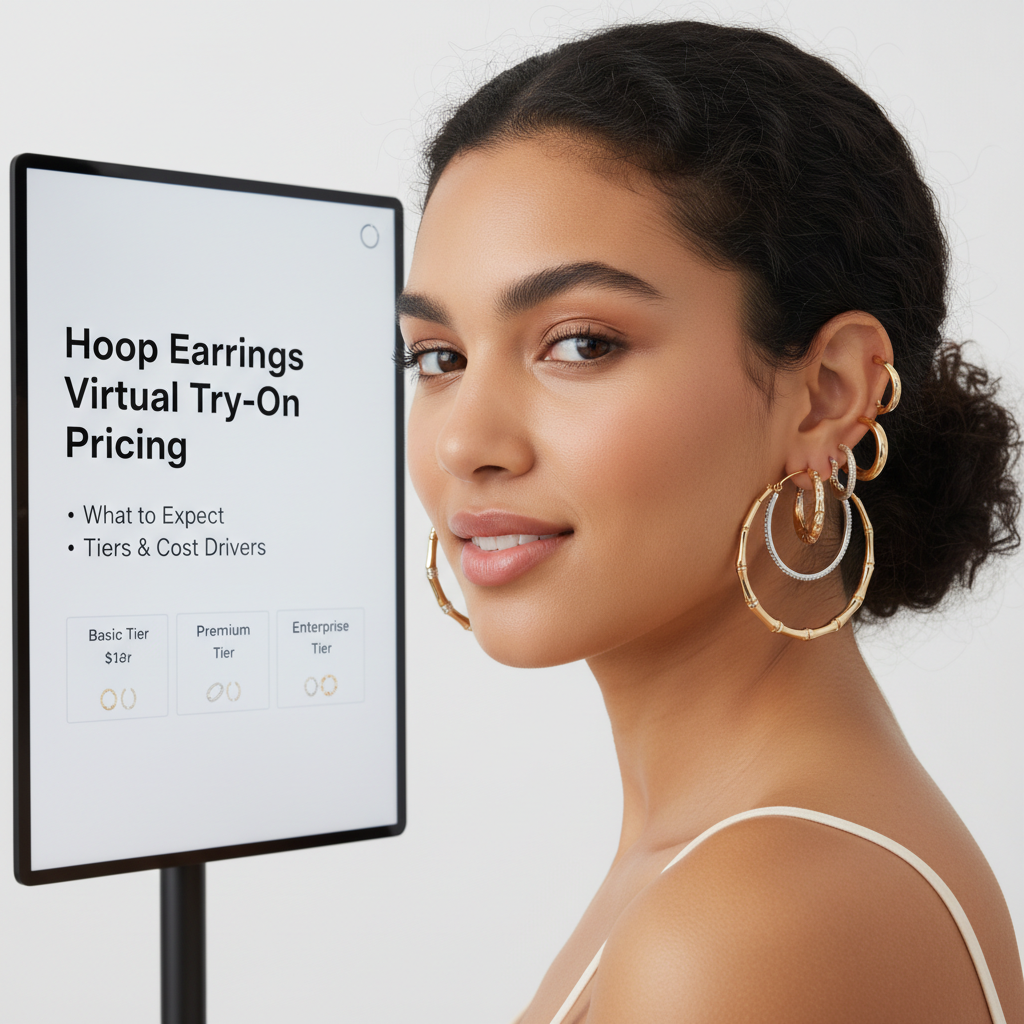
Jewelry Virtual Try On Services Indonesia: How to Choose the Best Jewelry Try On Vendor
Quick Summary
- Virtual Try-On (VTO) increases conversions and reduces returns by giving customers a realistic view of the jewelry’s size and shine.
- For the Indonesian market, link-based/no-code (web AR) solutions are often the fastest and most compatible with
- Tokopedia, Shopee, Instagram, and TikTok.
- Prioritize vendors with 3D realism, hand/ear tracking, fast live times, and local language support + SLA.
- Try the vendor within 1–2 hours: request a demo link, measure load time, assess realism, and test shareability.
Introduction — Why jewelry virtual try on services indonesian matters for your brand
You’re looking at jewelry virtual try-on services in Indonesia because you want shoppers to see—and feel—the product before purchasing. Virtual try-on (VTO) helps Indonesian jewelry brands increase conversions, reduce returns, and create a shareable shopping experience for mobile-first customers. For quick deployment without engineering overhead, tryitonme.com provides link-based, codeless VTO: purchase a 6-month plan based on SKU, submit standard product photos, tryitonme’s team/AI renders the AR, and you receive a ready-to-use try-on link for each SKU in less than 3 business days. View a demo or Book a Demo.
What is jewelry virtual try on? (web ar try on and 3d product try on explained)
Jewelry virtual try-on uses augmented reality (AR) and 3D rendering to superimpose rings, necklaces, bracelets, and earrings onto a live image or photo of the customer. Two common approaches:
Web AR try on (browser-based)
The experience runs in a mobile browser via a shareable link—no app required. It’s quick to access and ideal for product pages and social distribution. For a web vs. native AR comparison, read Postindustria’s analysis.
3D product try on
High-fidelity 3D models deliver metallic reflections, gemstone shimmer, and accurate scale. This is crucial for premium products where materials and comfort are key factors. 3D realism examples and guides are available on Banuba, and workflow notes are available in the iJewel3D docs. The differences between 2D and 3D for rings are explained in a brief article.
Avoid mistaking polished 2D overlays for true 3D—2D often looks flat and fails to show how a ring sits on a finger or how a necklace hangs.
Why Indonesian brands should adopt VTO now (jewelry virtual try on indonesian)
Indonesian is a mobile-first market—most shoppers browse and transact via smartphones on Tokopedia, Shopee, Instagram, and TikTok. Jewelry is tactile: customers worry about fit, scale, and the appearance of the metal or stone. These doubts lead to decreased sales and returns. VTO addresses these issues by increasing buyer confidence and providing a shareable experience.
Business case highlights
- Conversion lift: Studies show an increase in conversions after adding VTO (see conversion/return benefits at Iphygital). Also see the ROI ring example at Cermin.
- Return reduction: Visual accuracy reduces “not as pictured” returns (return context at Iphygital).
- Social & marketplace advantage: Shareable links work across Instagram, TikTok, WhatsApp, and marketplace listings—customers can try, share, and buy without app friction.
Types of virtual try on technologies (comparison)
Web AR try on (browser-based)
Pros: No app install; immediate access via link; easy to share. Cons: Browser limitations can reduce the highest fidelity compared to native apps. Suitable when you need a fast time-to-market. Web vs. native comparison: Postindustria.
AR virtual try on (native / app / social)
Pros: advanced tracking and rendering in the app environment; higher fidelity. Cons: frictionless app installation, longer development cycles, higher costs. Use when the highest level of realism is needed for flagship apps or loyalty programs. Additional info: Postindustria.
3D product try on (high-fidelity models)
Pros: Accurate scale, photorealistic materials, realistic lighting—essential for premium rings and necklaces. See the 3D realism guide on Banuba and modeling notes on iJewel3D. Cons: Higher modeling costs and heavier assets.
Integration approaches — SDK/API vs link-based no-code
SDK/API: Deep integration into apps or marketplaces, but requires development, versioning, and maintenance time. Link-based no-code: Deployment without code via URL (the fastest path). For many Indonesian merchants, link-based solutions reduce time-to-market from weeks/months to hours/days; see the platform comparison on Postindustria.
Vendor evaluation checklist (jewelry try on vendor indonesian)
Use this checklist to screen vendors and give them an objective score.
Technical (rendering & tracking)
- 3D realism: metal finishes, gemstone reflections (Banuba reference).
- Tracking: hand/finger tracking for rings, ear/face tracking for earrings/necklaces (iJewel3D notes).
- Performance: load time and mobile CPU usage.
Deployment & channels
- Link-based/no-code for deployment via URL without SDK (important for marketplace listing compatibility).
- Channel compatibility: product pages, Shopee/Tokopedia (shopify guide/link), Instagram, TikTok, WhatsApp.
Speed & workflow
- Time-to-live: how quickly a SKU goes live after submission.
- Content workflow: bulk upload and catalog versioning.
Localization & reliability
- Indonesian language support and local onboarding.
- Hosting and latency for Indonesia; SLAs and local references.
Analytics & measurement
Conversion tracking, add-to-cart metrics, session engagement, and support A/B testing to validate ROI (see the conversion/return context in Iphygital and the analytics guide in Cermin analytics).
Privacy & security
Check camera data handling—local processing vs. server storage; permissions; and GDPR/PDPA compliance (privacy note: BelgiumWebnet).
Commercial & operations
Pricing models, pilot availability, and large SKU support.
How to compare vendors (practical side-by-side)
Use rubrics 1–5 across five categories: Ease of Deployment, Image/3D Quality, Local Support, Cost/Pilot Terms, and Analytics. Weight them according to your priorities. Platform comparisons for other contexts are available in the Cermin comparison.
Five-step live test (quick vendor trial — 1–2 hours)
- Request a demo link for one ring or necklace SKU.
- Open the link on a local mobile device (Jakarta or target region).
- Measure load time — target: under 2 seconds for main AR asset load.
- Realism 1–5 (metal finish, gemstone sparkle, scale). Aim for a minimum of 4 for premium items.
- Test shareability — send via WhatsApp/Instagram and confirm the experience remains accessible.
Why tryitonme.com is the Right Fit for Your Business (jewelry try on vendor indonesia)
tryitonme.com built for brands that need fast VTO without coding:
- Zero-code, link-based deployment—no SDK/API; product links can be shared across web, mobile, and social media.
- Fast onboarding and turnaround—purchase a 6-month plan based on SKU, submit a standard photo, the tryitonme team/AI processes the AR, and receive a try-on link in less than 3 business days (plan details).
- SKU-based scaling—easily elevate your pilot to a catalog.
- Cross-channel compatibility—deploy quickly to product pages, marketplaces, and social media.
- Hands-on onboarding minimizes internal development and design effort. Learn more or request a demo at tryitonme.com. For pricing plans, see Cermin pricing.
Implementation roadmap & timeline (for Indonesian brands)
30–60 day pilot plan:
- Week 0: Select 10–20 pilot SKUs and define KPIs (conversion uplift, return reduction).
- Days 1–7: Prepare imagery or 3D assets (standard photos: front/side if relevant).
- Days 4–10: Submit assets to vendors (with tryitonme: send photos, team/AI processes).
- By Day 3 (per SKU): Receive a shareable try-on link (tryitonme turnaround: under 3 business days).
- Days 10–30: Deploy link to website, Tokopedia/Shopee, and social posts; promote via WhatsApp and influencer DMs.
- Days 30–60: Measure KPIs, run A/B tests, evaluate expansion.
ROI & KPIs to measure (jewelry virtual try on indonesia)
Primary KPIs
- Conversion rate lift (see study on Iphygital).
- Add-to-cart uplift and session engagement (time on product page).
- Average order value (AOV) and return rate reduction (reference: Iphygital).
A/B test setup
Random route 50% pengunjung ke halaman VTO-enabled dan 50% ke halaman gambar statis. Bandingkan conversion, AOV, dan return rate selama 4 minggu.Randomly route 50% of visitors to a VTO-enabled page and 50% to a static image page. Compare conversion, AOV, and return rates over four weeks.
Example ROI (simple)
10,000 visitors/month; baseline conversion 2% → 200 orders. A 0.5 point increase (to 2.5%) = +50 orders. With an AOV of IDR 500,000 = IDR 25,000,000 additional revenue per month.
Pricing models & commercial considerations
Common models:
- Per-session (pay per try-on).
- Per-link or per-SKU (useful for catalog pilots).
- Monthly subscription (unlimited usage).
- Enterprise/custom pricing for large catalogs and integrations. Example of ring/jewelry pricing: Mirror pricing.
Negotiation tips for Indonesian
- Ask for a 30–60-day pilot discount.
- Confirm that the price includes Indonesian taxes (VAT/SST).
- Ensure Indonesian language onboarding and a localized SLA whenever possible.
Local success checklist & next steps (best jewelry try on indonesian)
- Budget: Define a pilot budget and pricing model.
- SKUs: Select 10–20 high-demand items.
- Timeline: Set a 30–60-day pilot window.
- KPIs: Conversion, return rate, target AOV.
- Team: Appoint an owner and contact vendors.
- Content: Prepare product photos or 3D assets.
- Vendor shortlist: Use a checklist and run a quick demo.
- Launch: Deploy links to product pages, Shopee/Tokopedia, and social media; monitor results.
CTAs
- View live jewelry virtual try on demo: tryitonme.com
- Book free vendor evaluation & pilot with tryitonme: tryitonme.com
SEO & content usage notes (for publishing)
The title and first paragraph already include the main keyword (jewelry virtual try-on services Indonesia). Use related keywords naturally in headings (web ar try-on, 3d product try-on, ar virtual try-on Indonesia). Embedding a live demo, explanatory video, before/after GIF, vendor checklist PDF, and vendor comparison table is recommended. Important internal link: tryitonme.com for demo/contact.
Writer checklist before publishing
- Verify conversion and return figures according to Iphygital sources.
- Confirm web vs. native claims in Postindustria.
- Validate 3D accuracy in Banuba and iJewel3D.
- Confirm privacy references in BelgiumWebnet.
- Ensure all CTAs lead to tryitonme.com.
Next step: see a live demo
If you want to quickly shortlist vendors and run a pilot that starts converting in weeks (not months), check out our live jewelry virtual try-on demo or Book a Demo.
FAQ
Is web AR try on private and secure?
Yes—many modern web AR solutions process camera frames locally and avoid storing images. Always verify the vendor’s privacy and data retention policies (see the privacy policy at BelgiumWebnet).
Do customers need an app?
No—web AR works in the browser via a link, which is important for mobile-first customers on Tokopedia and Shopee.
How accurate is 3D product try on for scale/fit?
High-quality 3D models provide accurate scale, lighting, and material behavior, perfect for rings and necklaces. See 3D guides on Banuba and iJewel3D.
How fast can a SKU go live?
With a proven link-based/no-code flow, some vendors (e.g. tryitonme) provide a try-on link per SKU in less than 3 business days after receiving a standard product photo.
What pricing models should I expect?
Common models include per-session, per-link/per-SKU, monthly subscriptions, or custom enterprise pricing. For example packages and pricing, see Mirror Pricing.