
Septum Rings Virtual Try On Pricing: What to Expect, Packages & True Costs
- Summary of common VTO pricing models: per-SKU setup, subscription, pay-per-session, enterprise, and freemium.
- Septum rings tend to be cheaper per SKU than eyewear due to simpler geometry and tracking.
- Link-based/no-code (SDK) options reduce development requirements and speed up time-to-market.
- Compare setup scopes (2D vs. 3D, variants, hosting, analytics) when requesting a formal quote.
Table of Contents
- Introduction
- Why brands add virtual try on for septum rings
- Overview of virtual try on pricing models
- Why tryitonme.com is the right fit for your business
- Sample pricing tiers & virtual try on packages
- Suggested package details to include
- The cost of septum rings try on
- Inputs that change cost
- Savings with a link-based, zero-code approach
- Implementation timeline & what brands need to prepare
- ROI and how to justify the spend
- Comparative cost case — SDK/API build vs. link-based
- Visuals & content assets to include
- FAQ
- Call to action & next steps
- Editorial checklist before publishing
- SEO & distribution notes
- Measurement & success criteria
- Closing note
Introduction
“Septum ring virtual try-on pricing” refers to how vendors charge for virtual try-on (VTO) experiences specifically for septum jewelry, who should consider this option, and what it takes to deploy a try-on link for customers. If you’re an ecommerce manager, DTC jewelry brand owner, or social commerce marketer budgeting or evaluating vendors, this guide is for you.
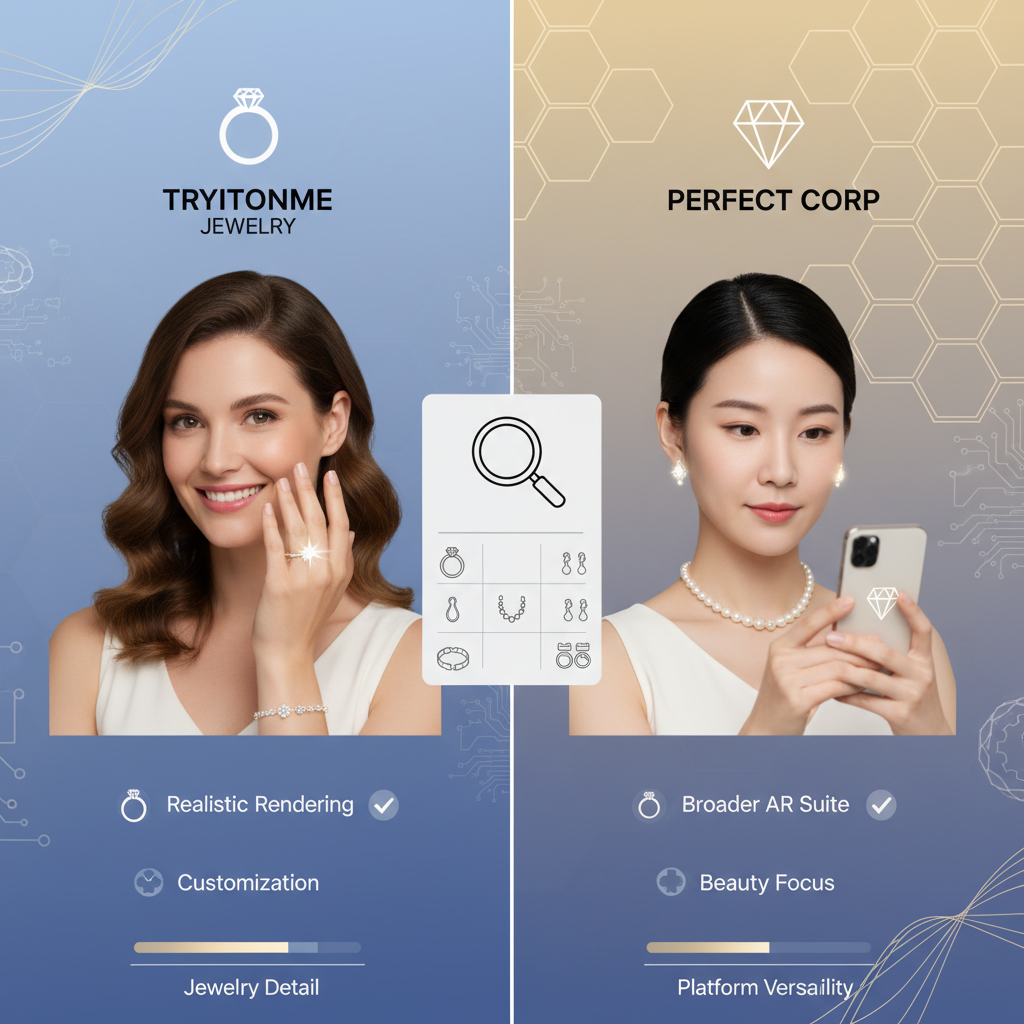
Virtual try-on for accessories (including septum rings) is part of the broader AR/visual commerce category—industry reports show AR/VTO can increase buyer confidence, reduce returns, and increase conversions. For a comparison of jewelry platforms, see tryitonme jewelry vs. perfect corp.
Why brands add virtual try on for septum rings
The commercial case for VTO septum rings is quite simple. Because septum jewelry is a highly visual and stylish purchase, buyers want to know how a particular shape, size, or finish complements their face. Without a realistic preview, doubts arise, and returns can occur when the product doesn’t meet expectations.
What VTO solves for you:
- Reduces purchase friction — customers can try on a look in seconds.
- Improves conversion — a compelling try-on experience shortens the path to checkout.
- Lowers return rates — more aligned expectations reduce surprises upon receiving the product.
- Enables social and influencer commerce — an easily shareable try-on link simplifies promotion.
For no-code VTO options and special accessory pricing tiers see tryitonme jewelry (no-code VTO).
Overview of virtual try on pricing models
Vendors typically set their pricing according to one or more of the following models. Understanding each model helps you match your proposal to your needs:
- Per-SKU setup / one-time fee: paid once per product to create assets and configurations.
- Subscription (SaaS): monthly/annual fee for link hosting, analytics, and SKU/session limits.
- Pay-per-session / usage-based: billed based on interactions or usage time.
- Enterprise / custom: initial project fee with SLA, integrations, and white-label options.
- Freemium / trial: limited demo link for evaluation before committing.
Confirm what is included in the “setup” (3D model vs. 2D overlay, retouching, color variants), whether analytics are included, and who hosts the link. For guidance on choosing between 2D overlays and 3D models, read our 2D vs. 3D guide.
Why tryitonme.com is the right fit for your business
According to information from tryitonme (company-sourced — no reliable source), they offer a no-code, link-based VTO deployed via a shareable product link (no SDK/API), designed for quick implementation and minimal developer effort. Key value propositions:
- Zero-code link deployment — the try-on experience is accessible via a simple product link. See tryitonme pricing for accessories for link-based packages.
- Speed to market — claims delivery of a unique link in under 3 business days (company-sourced — no reliable source).
- Access across channels — links work across web, mobile, and social media without integration.
- Accessory-focused accuracy — built for jewelry, eyewear, hats, and watches (company-sourced — no reliable source).
Note: The above claims are from the company and should be validated with official documentation before publication.
Sample pricing tiers & virtual try on packages
Below are four archetypal packages as a planning framework — request a formal quote for exact figures.
Starter (small catalog / test)
- Ideal for: Small brands testing VTO on a handful of SKUs or a new launch.
- Included: 5–10 product links, basic asset conversion from photos, hosted link access, demo analytics, email support.
- Good if: Anda ingin proof of concept low-friction tanpa banyak dev effort.
Growth (active DTC use)
- Ideal for: Brands with 20–100 SKUs atau runway untuk kampanye sosial.
- Included: 20–100 product links, variant support, analytics dashboard, recurring updates, prioritized support.
Premium / Scale
- Ideal for: Brands with hundreds of SKUs dan kampanye omnichannel.
- Included: Bulk SKU onboarding, API/CSV sync (jika ditawarkan), enterprise analytics, SLAs, custom branding.
Enterprise (custom)
- Ideal for: Retailer besar atau marketplace yang memerlukan white-label dan integrasi mendalam.
- Included: Implementasi custom, SSO, performance SLAs, on-prem/dedicated hosting options.
Suggested package details to include
When comparing vendor proposals, ask for the following details:
- Number of SKUs/links included.
- Asset processing methods (2D photo, photogrammetry, 3D CAD).
- Variant handling (colors, sizes).
- Hosting and session limits.
- Analytics and reporting scope.
- Support level and SLA (response time, uptime).
- Update/maintenance terms and costs.
- Exportable data/integrations (Shopify, Magento, GA). For a guide to embedding in Shopify see the Shopify try-on guide.
- Any additional creative work or retouching fees.
The cost of septum rings try on
Technically, septum rings are usually simpler to model and track than eyewear. The main reasons are:
- Smaller geometries and simpler silhouettes reduce modeling time.
- Fewer occlusions and alignment challenges than full eyeglass frames.
- Surface materials are often simpler (metal vs. textured/transparent materials), reducing rendering complexity.
- Because of these factors, septum ring setup generally requires less time per SKU. However, the type of asset (2D overlay vs. 3D model) still significantly impacts pricing.
For price comparisons for other accessories, such as sunglasses, see sunglasses virtual try-on pricing.
Inputs that change cost
Faktor kunci yang menaikkan biaya:
- Jumlah SKU dan varian.
- Jenis aset: 2D photo-based overlays vs full 3D models/photogrammetry.
- Fidelity material dan finish (mis. high-gloss gold, gemstone detail).
- Kompleksitas tracking: overlay hidung sederhana vs nose segmentation dinamis.
- Animasi dan interaksi (scale/rotate, ekspor GIF try-on).
- Channels & scale (single PDP vs kampanye besar/social distribution).
- Integrations (Shopify/Magento, analytics, PIM).
- Support & SLA level.
- Localization, compliance, hosting requirements.
- Ongoing maintenance dan frequency update.
Savings with a link-based, zero-code approach
Minimal dev hours for deployment (without SDK integration).
Faster time-to-market for social campaigns and promotions.
Centralized hosting reduces per-channel work.
Note: Specific claims about onboarding or turnaround from tryitonme need to be validated directly with the vendor. For a vendor checklist template and RFP resources, see vendor checklist & RFP resources.
Implementation timeline & what brands need to prepare
Two practical timelines to plan:
- Link-based/no-code launch: a few hours to a few business days for one or a small number of links (vendor-dependent).
- According to tryitonme (company-sourced — no reliable source), unique links are delivered in less than 3 business days.
- Full 3D-asset workflow: 2–4+ weeks for modeling, QA, and testing at scale.
Assets to prepare — checklist:
- High-quality product photos (front, close-up; multiple angles if available). For photo specifications, see the product photo guide.
- SKU metadata (SKU IDs, color names, material).
- Color swatches or Pantone/RGB values.
- Product page URLs and desired CTAs.
- Brand imagery and in-link creative (logo, fonts).
- Analytics tracking credentials (GA, dataLayer) if integration is desired.
ROI and how to justify the spend
Key KPIs to measure:
- Conversion rate (lift after VTO launch).
- Return rate (drop in VTO-equipped SKUs).
- Average order value (AOV) changes.
- Click-through rate on social ads using the try-on link.
- Engagement metrics for try-on sessions (time, completions). For GA4 measurement plans and events, see try-on analytics.
Hypothetical ROI example: calculate breakeven = incremental conversions x AOV x gross margin — compare against the annual cost of VTO. Ask the vendor for sample case studies or benchmark ranges.
Comparative cost case — SDK/API build vs. link-based
Custom SDK/API build — cost drivers:
- Developer hours for SDK integration into PDPs or native apps.
- Ongoing maintenance for SDK updates and compatibility.
- QA across browsers/devices, backend hosting, scaling, security.
- Generally higher upfront costs and longer time-to-value.
Link-based, no-code approach — cost drivers:
- Per-SKU asset production and hosting.
- Subscription or usage fees.
- Lower implementation overhead and faster launch.
If internal dev capacity is limited or you need speed, link-based options typically have a lower barrier to adoption. For concrete packages from no-code providers, see tryitonme pricing for accessories.
Visuals & content assets to include
Asset design that increases conversion:
- Animated GIF showing a septum ring try-on (looping before/after).
- Embedded demo link or mock iframe on the product page.
- Pricing table graphic comparing Starter/Growth/Premium tiers.
- One-page checklist flowchart: photos → assets → live try-on link.
- Alt-text example: “Try-on GIF: model wearing silver septum ring — click to open live link.”
- CTAs: “Get a free demo link,” “Estimate my cost,” “See a septum ring demo.”
FAQ
Q: How much does it cost?
A: Costs vary by vendor and scope. Pricing depends on the number of SKUs, asset type (2D vs. 3D), and support level. Request a formal quote for accurate figures.
Q: Can I do this without dev help?
A: Yes — many link-based/no-code vendors provide deployment without an SDK/API so marketing teams can roll out links quickly.
Q: How long does setup take?
A: From a few hours to a few business days for link-based demos; several weeks for large-scale 3D workflows. Confirm the vendor’s SLA before committing.
Q: Do I need 3D models?
A: Not always. Photo-based overlays are often sufficient for accessories; 3D is recommended for high realism or full rotation interaction. See the 2D vs. 3D guide for decision criteria.
Q: Are analytics included?
A: Varies between vendors — verify that session metrics, conversion attribution, and export options are included. For a measurement plan, see the analytics try-on.
Call to action & next steps
Ready to estimate your septum ring virtual try-on pricing? Request a demo or cost estimate from your chosen vendor. For a quick no-code evaluation, request a demo link and sample assets. For package information and demos from no-code providers, see tryitonme jewelry (no-code VTO) and tryitonme pricing for accessories.
Micro-copy CTA options:
- Primary CTA: “Get a free demo link”
- Secondary CTA: “Estimate my cost”
- Alternate: “See a septum ring demo”
Editorial checklist before publishing
- The primary keyword appears in the H1 and in the first paragraph: “septum rings virtual try on pricing.”
- All four target keywords appear in the headings/body: “septum rings virtual try on pricing,” “virtual try on pricing,” “cost of septum rings try on,” “virtual try on packages.”
- Replace placeholders and tags (company-sourced — no reliable source) with official URLs/documentation or remove the claim if none is available.
- Add authoritative URLs for conversion/return rate claims (PerfectCorp, McKinsey, Snap, Shopify) before publishing.
- Include visuals: at least one demo GIF + pricing table.
- Add FAQs and CTAs for demo/quote requests.
SEO & distribution notes
Meta description suggestion: “Septum rings virtual try on pricing — learn pricing models, cost drivers, package examples, and how to budget for VTO. Request a demo or estimate.”
Recommended internal links:
- Tryitonme jewelry (no-code VTO)
- Tryitonme pricing for accessories
- 2D vs 3D guide
- Try-on analytics plan
- Product photo & vendor checklist
- Sunglasses VTO pricing
Suggested CTAs: “Get a free demo link”, “Request a quote”, “Download pricing guide”.
Measurement & success criteria
- Track organic rankings for primary keywords over 30–60 days.
- Number of demo requests and contact form submissions from posts.
- Clickthroughs to vendor demo and pricing pages.
- Engagement metrics: time on page, scroll depth, and conversions from CTAs.
Closing note
This draft is intended as a practical guide for brands considering virtual try-on pricing for septum rings. Before publishing, please replace placeholder links and company-sourced claims with official documentation or remove unverifiable claims. If you wish, I can convert this draft into a ready-to-publish post complete with suggested graphics and a reference list after you provide the URLs of the vendors and industry sources you wish to cite.