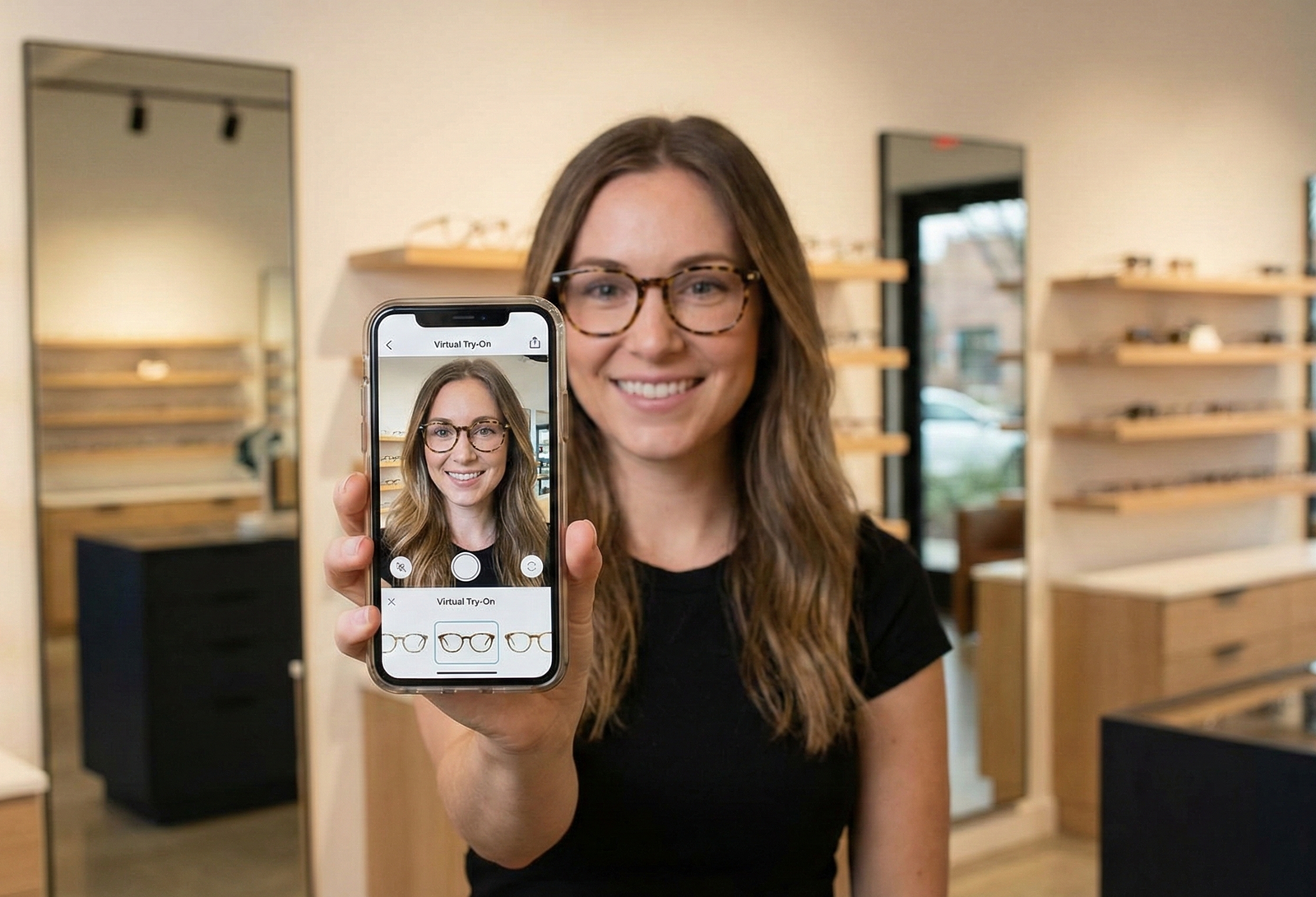
ROI Optical Frames Virtual Try On: How Link-Based VTO Boosts Conversion, AOV, and Lowers Returns
- Link-based, zero-code VTO enables fast pilots and measurable ROI without heavy engineering.
- Measure ROI with gross-profit-based formulas: Incremental Revenue, Returns Savings, Net ROI.
- Primary impacts: higher try-on engagement, improved try-on-to-purchase conversion, increased AOV, and reduced returns.
Introduction
You’re reading this because you want to understand roi optical frames virtual try on — how to calculate it and how to realize it fast with minimal engineering. This post shows a practical, measurement-first approach to estimating the business impact of virtual try-on (VTO) for eyewear and explains why a link-based, no-code VTO (like tryitonme.com) is the fastest path to results. For industry context on AR commerce adoption and retail strategy, see Perfect Corp’s AR commerce overview and McKinsey’s retail/consumer insights hub. For practical guidance on pricing specifically for optical frames, see our buying guide.
Why eyewear needs virtual try-on now
Online eyewear sellers face a distinct problem: customers can’t hold frames up to their face before buying, and small differences in fit or style often determine whether someone keeps or returns a pair. That uncertainty drives friction at multiple points in your funnel. For a practical product-team view on measuring and improving fit (PD/IPD and temple fit), see our frame fit guide.
Pain points at a glance
- Low confidence at product discovery: shoppers hesitate to click “buy” without seeing frames on their face.
- High return risk: wrong fit or unexpected style leads to post-purchase returns and cost.
- Limited engagement: static photos don’t convey how frames look from different angles or on different faces.
Visual fit matters for eyewear — studies and vendor reports on AR/VTO emphasize that visualization and try-on reduce uncertainty and increase purchase intent (see Perfect Corp). Retail returns and fit-related friction are also well documented in retailer strategy discussions (see McKinsey).
What virtual try-on delivers for optical frames (benefits mapped to metrics)
Virtual try-on moves customers from hypothetical to confident purchase decisions. Below are the primary outcomes VTO influences, with notes on what VTO directly changes versus supporting factors you should also control (e.g., PDP content quality).
Key outcomes VTO influences
- Try-on engagement: more sessions include a face-try action (directly influenced).
- Try-on-to-purchase conversion rate: share of people who try and then buy (directly influenced).
- Overall site conversion: lift driven by increased confidence and faster decisions (partly influenced).
- Average order value (AOV): buyers may add higher-priced frames or accessories after trying (indirectly influenced via post-try merchandising).
- Returns reduction: fewer returns when expectations match reality (mechanism-driven; see later).
Vendor overviews summarize these commerce benefits and case examples: Perfect Corp’s business overview and ThreeKit’s commerce success stories. Learn more about the tryitonme eyewear platform and how link-based deployment works.
Key metrics VTO impacts
Keywords: try on conversion rate
Definitions and things to track
- Try-per-session (try-on engagement rate): TryStarts ÷ Sessions. Event:
try_start. - Try-on conversion rate: TryCompletes who purchase ÷ TryCompletes. Events:
try_complete,order_placed. - Overall conversion uplift: (Orders_with_VTO − Baseline_Orders) ÷ Visitors.
- AOV impact: AOV_after_tryers − AOV_non_tryers.
- Return rate (post-purchase): Returns ÷ Orders.
Instrument these events in your analytics: try_start, try_complete, try_to_cart, order_placed, order_returned. These let you attribute revenue and returns savings to VTO activity. For a practical measurement plan and GA4 event mapping for eyewear VTO, see: GA4 event mapping guide.
How to measure virtual try-on ROI (formula + calculator)
Keywords: virtual try on roi
Use gross profit for ROI calculations (not revenue) if you want profit-based ROI. Below are clear formulas and instructions on where to source inputs (analytics, P&L, fulfillment cost data).
Formulas (canonical)
- Incremental Revenue = Visitors × Try‑On Rate × Try‑On Conversion Uplift × AOV
- Returns Savings = (Baseline return rate − Post‑VTO return rate) × Orders × AOV × cost‑to‑fulfill factor
- Net ROI = (Incremental Revenue + Returns Savings − Cost of VTO) / Cost of VTO
Notes on inputs
- Visitors: number of relevant PDP visitors over the measurement period (analytics).
- Try-On Rate: percentage of visitors who initiate a try-on (
try_starts ÷ visitors). - Try-On Conversion Uplift: incremental conversion rate among try-on users attributable to VTO (measure via A/B test).
- AOV: average order value for the product category (analytics/commerce platform).
- Baseline/Post‑VTO return rates: historical returns vs returns after VTO rollout (returns system/ERP).
- Cost‑to‑fulfill factor: fraction of AOV that represents cost to fulfill a returned order (shipping + restock + gross margin impact).
- Cost of VTO: total paid over the measurement window (platform fee, setup, creative).
Example calculation (illustrative scenarios)
Keywords: virtual try on roi
Below are three labelled “illustrative example” scenarios — replace inputs with your real data.
Common inputs (monthly)
- PDP Visitors: 20,000
- AOV: $120
- Baseline conversion rate: 1.8% (illustrative)
- Baseline return rate: 18% (illustrative)
- Cost-to-fulfill factor for returns: 50% of AOV (illustrative)
Scenario assumptions (illustrative)
- Try-on rate: conservative 6% / mid 12% / aggressive 20%
- Try-on conversion uplift: conservative +5 ppt / mid +10 ppt / aggressive +20 ppt
- Post-VTO return rate decreases by: conservative 1 ppt / mid 3 ppt / aggressive 5 ppt
- Monthly cost of VTO: $1,200
Compute Incremental Revenue example (mid scenario)
Incremental Revenue = 20,000 × 0.12 × 0.10 × $120 = $28,800
Returns Savings (mid)
Orders attributable to VTO = 20,000 × 0.12 × 0.10 = 240 orders
Returns reduction per order savings = 0.03 × $120 × 0.5 = $1.80
Returns Savings = 240 × $1.80 = $432
Net ROI (mid)
Net ROI = ($28,800 + $432 − $1,200) / $1,200 = 23.36 → 2,336% (illustrative)
Interpretation: replace inputs with your analytics to calculate true ROI. The formula is transparent and plug-and-play for your P&L.
Benchmarks & expected uplifts (practical ranges)
Keywords: virtual try on roi
Public benchmarks vary by vendor, audience, and implementation. Vendor overviews and case stories describe meaningful engagement and conversion improvements — see Perfect Corp and ThreeKit. Because independent, standardized benchmarks for eyewear VTO are limited, the best approach is a short A/B test to establish your baseline.
Illustrative planning ranges (no reliable source)
- Try-on engagement rate (try-per-session): 4% → 12% → 20%
- Try-on-to-purchase uplift: +2 → +8 → +20 percentage points
- AOV uplift for tryers vs non-tryers: +2% → +6% → +12%
- Returns reduction for VTO buyers: 0.5 → 3 → 6 percentage points
Drivers of variability: traffic source quality, PDP UX, price points, brand familiarity, and promotion of the try-on. For mobile performance considerations, see our mobile performance guide.
Case study / sample results (hypothetical retailer)
Keywords: try on conversion rate
Hypothetical 8‑week pilot (anonymized, illustrative)
- Retailer: Direct-to-consumer eyewear brand
- Setup: link-based VTO added to PDP for 50 SKUs; traffic split 50/50 treatment vs control
- KPIs tracked:
try_start,try_complete,try_to_cart, orders, AOV, returns
Results (illustrative): try-on rate 11%; try-on conversion rate 7% (vs control 1.8%); net uplift in overall conversion +0.9 ppt; AOV for buyers who tried +$8; return rate among tryers −2 ppt. Outcome: payback in <3 months on platform fees (illustrative).
Why tryitonme.com is the Right Fit for Your Business
Keywords: roi optical frames virtual try on, no-code VTO
- Accuracy of accessory VTO: team + AI processing of standard product photos for realistic frame fitting.
- Speed: receive a ready-to-use try-on link in under 3 business days.
- Zero-code, link-based deployment: no SDK or engineering integration required — shareable links work across web, mobile, and social.
- Low friction testing: 6‑month package model for fast pilots and measurable ROI without heavy contracts.
Onboarding (quick): 1) Purchase a 6‑month package. 2) Send standard product photos (front/side for eyewear). 3) tryitonme team/AI handles AR processing. 4) Receive your unique try-on link in under 3 business days. See a platform overview: tryitonme eyewear overview.
Call to action: Book a Demo.
Quick deployment walkthrough (link-based, zero-code)
Keywords: try on conversion rate
Implementation steps
- Receive link for each SKU.
- Add to product pages via a CTA button or image link. Platform-specific guidance: Shopify guide, WooCommerce guide.
- Use link in social ads, email, and QR codes for in-store.
Top placements to increase try on conversion rate
- PDP CTA (“Try on in 10s”)
- Add-to-cart modal (nudge try before checkout)
- Post-purchase upsell email (“See how matching frames look”)
- Paid social creative with “Try Now” deep link
- In-store QR for click-to-try
UTM recommendation: ?utm_source={channel}&utm_medium={placement}&utm_campaign=vto_pilot
Best practices to maximize try-on conversion rate and AOV
Keywords: try on conversion rate
Priority CRO checklist
- Clear CTA: “Try frames on in 10s” with visible button on hero image.
- Show social proof: photos of real customers + short video demo.
- Offer multiple angle views and quick style-switch controls.
- Post-try merchandising: “You tried — complete the look” upsell bundles.
- Speed messaging: emphasize instant/no-download try-on.
Instrument analytics events: try_start, try_complete, try_to_cart, add_to_cart, order_placed, order_returned. Watch for drop-offs between try_complete → try_to_cart. For product photo guidance that improves realism and reduces calibration issues, see our photo requirements guide: photo requirements.
How virtual try-on drives returns reduction
Keywords: returns reduction try on
Mechanisms & illustrative savings:
- Better expectation setting: customers see real proportions and styling, reducing surprises.
- Reduced fit-related returns: virtual fit reduces returns for fit/appearance reasons.
- Fewer returns lower logistics, restocking, and margin erosion costs.
Use the Returns Savings formula above to quantify savings in your P&L. Public studies directly linking VTO to precise return reductions are limited — present numeric claims as illustrative unless you have trackable sources. For a deeper dive into accuracy factors that affect returns (landmarking, occlusion, pose, and size/fit calibration) see: accuracy factors.
A/B test plan and KPIs to prove ROI quickly
Keywords: try on conversion rate
- Test: PDP with VTO link (treatment) vs standard PDP (control).
- Variants: CTA copy (“Try On” vs “See It On”), placement (hero vs add-to-cart modal).
- KPIs: try-on rate, try-on conversion rate, overall conversion, AOV, return rate.
- Timeline & sample sizes: if PDP traffic >10k/month, run 4–6 weeks; use sample size calculators and guidance from Optimizely.
- Statistical significance: 95% confidence typical; consider practical significance.
Objections, limitations, and mitigation
Common concerns:
- Device/browser compatibility: modern web AR works on most up-to-date mobile browsers; developer guidance at MDN. If you need full device coverage, use link-based fallback flows.
- Privacy: avoid storing video — use local or ephemeral sessions and clear privacy messaging.
- Performance: server-side AR processing reduces client CPU load and ensures consistent visuals. See mobile performance guidance: mobile performance.
- Setup complexity: link model removes SDK/API integration; minimal to no engineering required.
Next steps & call to action
Keywords: roi optical frames virtual try on
- Request a 3‑day pilot link or Book a Demo.
- Download the ROI calculator (get a tailored spreadsheet during demo) — use UTM:
?utm_source=blog&utm_medium=post&utm_campaign=vto_roi_demo. - Run a 4–6 week A/B test on a cohort of PDPs and measure
try_start→order_placedand returns.
Appendix / assets & editorial checklist
Required deliverables:
- Three-scenario ROI calculator (conservative, mid, aggressive) — use the formulas above.
- One anonymized or clearly hypothetical pilot example (labelled hypothetical if no customer data).
- Funnel pipeline diagram (Visitors → TryStarts → Orders → Returns).
- Screenshots of a tryitonme link in PDP/email/social.
- CTA buttons: “Book a Demo” (demo), “Request 3‑Day Pilot Link” (request pilot).
- For pricing plan comparisons across no-code VTO packages, see the tryitonme pricing overview: tryitonme pricing.
Sources
- Perfect Corp — AR commerce overview
- McKinsey — retail & consumer insights
- ThreeKit — commerce case examples
- tryitonme product/demo
- Optimizely — A/B testing resources
- Mozilla Developer Network — WebXR/WebAR guidance
FAQ
1. How fast can I run a pilot?
With link-based VTO you can receive a pilot link in under 3 business days after submitting standard product photos; run a 4–6 week A/B test for statistically useful results if traffic allows.
2. Do I need engineering support to deploy VTO?
No. Link-based, zero-code VTO requires no SDK integration: add buttons or image links to PDPs, use deep links in ads, email, or QR codes.
3. How should I measure ROI?
Use gross-profit-based formulas: compute Incremental Revenue from try rates and uplifts, add Returns Savings, subtract Cost of VTO, then divide by Cost of VTO for Net ROI. Instrument events like try_start, try_complete, order_placed, and order_returned to attribute outcomes.
4. Will VTO reduce returns?
Mechanically, VTO reduces expectation mismatch and fit-related returns; quantify this using the Returns Savings formula and verify via post-launch returns tracking. Public, precise links between VTO and return reduction are limited, so treat numeric savings as illustrative until validated in your environment.
5. Which KPIs are most important for proving impact?
Primary KPIs: try-on rate, try-on conversion rate, overall conversion, AOV, and return rate. Track funnel events and run an A/B test to isolate VTO impact.
6. What are common limitations and mitigations?
Limitations: device/browser compatibility, privacy concerns, and mobile performance. Mitigations: link-based fallbacks, ephemeral/local sessions, server-side AR processing, and mobile performance tuning.