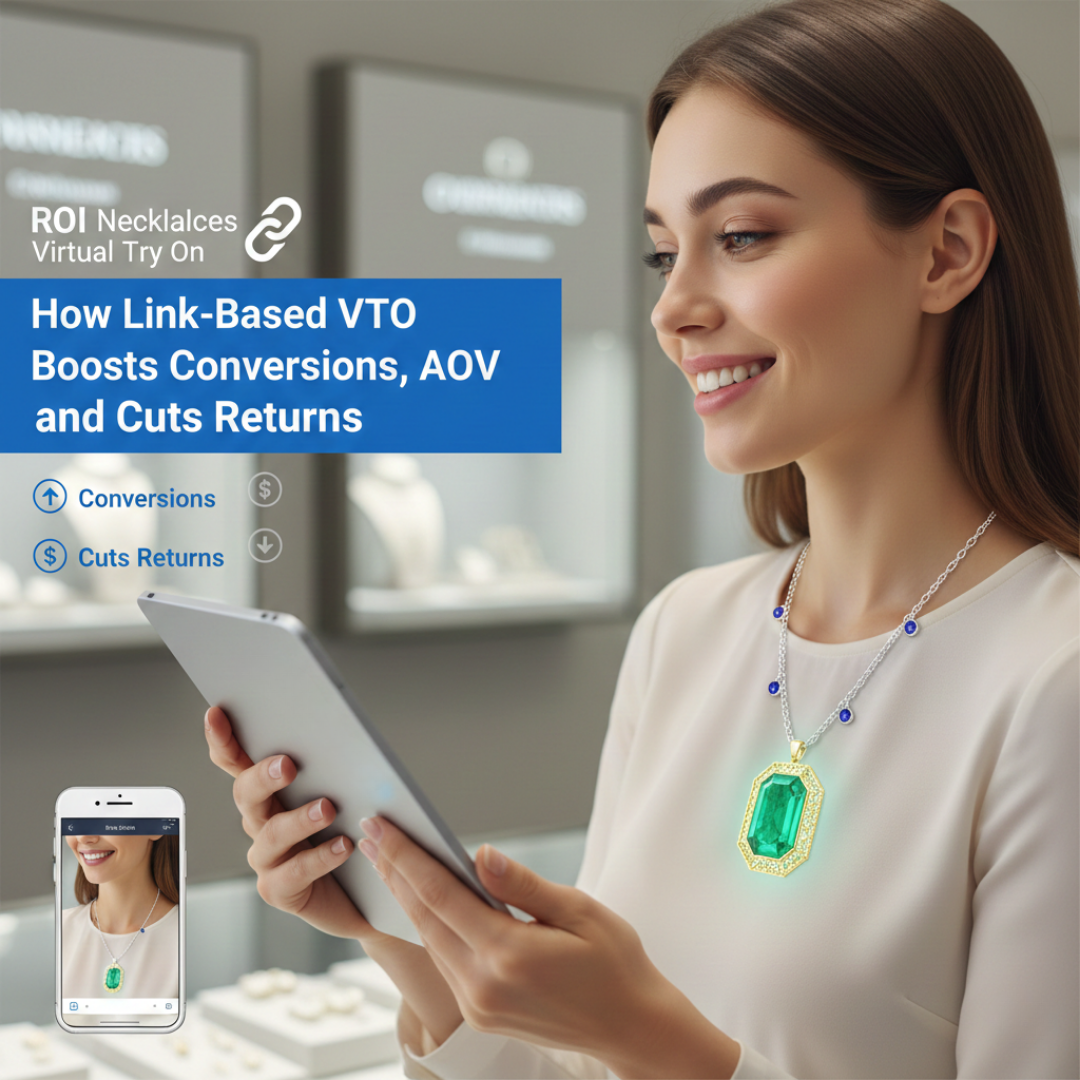
 ROI Necklaces Virtual Try On: How Link-Based VTO Boosts Conversions, AOV and Cuts Returns
Introduction — roi necklaces virtual try on
You want measurable uplifts from every new tool you add to the site — that’s why roi necklaces virtual try on matters. This post walks you through the business case, the metrics to track, a worked ROI example, and a fast implementation plan using tryitonme.com’s zero-code, link-based VTO (link delivered in under 3 business days) so you can realize conversion, AOV and returns benefits without engineering lift. Sources below show typical conversion uplifts and returns reduction ranges to frame realistic expectations.
Why necklaces benefit from virtual try‑on (try on conversion rate)
Necklaces are a visual, scale-sensitive product. VTO addresses shopper uncertainty and raises purchase confidence — which drives the try on conversion rate. Key reasons:
- Fit & length clarity: Necklaces vary by chain length and sit differently on each neck; VTO shows true positioning rather than relying on model shots (see: virtual try-on for necklaces). For pricing and packaging references see necklaces VTO pricing.
- Scale & proportion: Customers need to judge pendant size and chain thickness against their body and neckline to avoid surprises (see: jewelry ecommerce trends).
- Layering decisions: Buyers often mix necklaces; real-time previews reduce hesitation and encourage add-ons (see: layering with VTO). Implementation tips: jewelry try-on UX for Shopify.
- Behavioral lift: Studies and vendor reports show higher intent — for example, many brands report 25–40% conversion lifts when VTO is applied and increased likelihood to buy after using AR tools (see: brands using virtual try-on).
What “virtual try on ROI” looks like for necklaces (virtual try on roi)
Define virtual try on roi simply: the net profit contribution from VTO divided by the cost to run it. Core revenue and cost levers are outlined in industry primers (see: ROI for rings VTO).
- Conversion lift: VTO often delivers a 25–40% lift in conversion for try-on users.
- AOV uplift: Adding try-on-driven bundles/upsells can increase AOV (examples show +33% in some merchandising cases).
- Returns reduction: AR previews commonly reduce returns by ~20–30% for jewelry (source; additional report).
- Acquisition efficiency: Higher conversion and AOV reduces CAC per dollar of revenue, shortening payback windows (see: conversion uplift analysis).
Key metrics to track (KPI dashboard) — try on conversion rate
Make a compact weekly dashboard focused on the following KPIs and definitions. Target uplifts are drawn from the sources linked below.
- Try on conversion rate: % of users who used VTO and purchased (target: +25–40% vs. baseline) — source: industry report.
- Try-to-cart rate: % of try sessions that add product to cart (instrument try_started → add_to_cart).
- PDP conversion rate: overall product-page-to-purchase conversion (target improvement: +10–100% reported ranges) — source: case summaries.
- AOV & units per order: average order value and items/order (target +33% for bundled merchandising) — source: merchandising examples.
- Returns rate (tried SKUs): % returns for items that were tried (target reduction: 20–35%) — source: returns data.
- Engagement metrics: try rate (sessions that launch VTO), session time, shares — engagement lifts reported ~200% in some channel uses — source: engagement report.
Instrument events: try_started, try_to_cart, try_to_purchase, try_share. See an analytics primer for try-on events: try-on analytics guide. Track weekly and report monthly ROI to stakeholders (merch, growth, ops).
How to calculate ROI for necklace VTO (virtual try on roi)
Formula (source): ROI = (Incremental gross profit from VTO − Cost of VTO) / Cost of VTO (source).
Worked monthly example (numbers & sources)
Inputs (from example in industry summary):
- Traffic: 10,000 visitors/month (assumption).
- Baseline conversion: 1.5% (example case) — source.
- Baseline AOV: $70 — source.
- Margin: 60% (assumption).
- Returns baseline: 10% of orders.
- VTO impacts applied: conversion uplift 20%, AOV +10%, returns reduction 20% — source; source.
- VTO cost: $99/month (example pricing referenced) — pricing example; vendor pricing reference: tryitonme pricing.
Calculation steps:
- Baseline monthly revenue = visitors × conv × AOV = 10,000 × 1.5% × $70 = $10,500.
- Baseline gross profit = revenue × margin = $10,500 × 60% = $6,300.
- Baseline return cost (assumption) ≈ $630.
- Post-VTO conv = 1.5% × 1.20 = 1.8%. Post-VTO AOV = $70 × 1.10 = $77.
- Post-VTO revenue = 10,000 × 1.8% × $77 = $13,860. Post-VTO gross profit = $13,860 × 60% = $8,316.
- Returns down 20% → return cost drops from $630 to $504 (savings = $126) — sources: returns reduction; industry.
- Incremental profit = (8,316 − 6,300) + $126 = $2,142 + $126 = $2,268.
- ROI = ($2,268 − $99) / $99 ≈ 2,189% for that month (rounded) — see related worked examples: source.
Sensitivity scenarios (ranges):
- Conservative: conv +10%, AOV +5%, returns cut 15% — positive but smaller ROI.
- Realistic: conv +20%, AOV +10%, returns cut 20% — rapid payback (illustrated above).
- Aggressive: conv +40%, AOV +33%, returns cut 30% — very large ROI (range references: mocky.ai, onix-systems).
Note: traffic, margin and exact costs are your inputs — label them as assumptions in your model and re-run for production numbers.
Real-world impact: conversion & returns (try on conversion rate)
Short, evidence-backed examples:
- TrendForward (industry report): reported multimillion-dollar incremental revenue and substantial returns savings after broad VTO adoption; summarized in industry write-ups (source).
- Marketplace summaries: brands experiencing 25–40% increases in conversion where VTO is applied and AOV jumps from focused merchandising (source). Additional reference: ROI earrings VTO.
- Hypothetical example: a mid-market jewelry brand sees try-on users convert 25% more and return 20% less — plug into your ROI model to quantify impact.
Recommendation: add an anonymized tryitonme.com client quote pre-publish to increase credibility.
Why tryitonme.com is the Right Fit for Your Business (returns reduction try on, try on conversion rate)
- Zero-code, link-based VTO — no SDK/API development required; links work across web, mobile, social and ads (fast deployment approach referenced in industry reviews: qreal on necklaces). See vendor overview: tryitonme no-code VTO.
- Rapid onboarding — buy a 6‑month package → send standard product photos → our team/AI processes AR → you receive a unique try-on link in under 3 business days.
- Accurate accessory VTO — tuned for necklaces, pendants and layering (best-practice context: onix-systems).
- Speed to value — minimal dev cost and immediate link distribution shortens payback timeframe (industry commentary: mocky.ai).
Book a Demo: tryitonme.com/sales-demo
Try a live necklace VTO: tryitonme demo necklace link
How tryitonme.com’s no-code, link-based VTO accelerates virtual try on roi
Mechanics and time-to-value benefits:
- Link-based flow: tryitonme.com creates a unique product link you can drop into PDPs, Instagram Stories, paid ads, email and SMS — no engineering cycles (concept validated in industry comparisons: comparison; jewelry trends).
- Channel examples: PDP “Try On” button, Instagram Story swipe-up, paid social ad CTA, SMS blast to high-intent customers — all launch the same link and report events.
- Time-to-value: link-based deployments commonly go live in days vs. weeks/months for SDK or full-site integrations, shortening CAC payback windows (source: industry).
Optimization and testing plan to maximize try on conversion rate
Tactical playbook:
- Primary A/B: VTO PDP vs. control PDP. Sample guidance: 8–12 weeks, ~5,000 visitors per arm for 80% power (industry guidance: fytted).
- Secondary tests: CTA text (“Try On” vs. “See on Me”); auto-launch VTO vs. click-to-open; pre-fill size presets; different thumbnail art (model + on-neck image).
- UX dos: show model + live preview, add clear “length selector,” offer layering presets. Don’ts: force auto-launch with no close, hide try-on behind multiple clicks (UX guidance: mirrar UX).
- Measurement window: weekly monitoring; full A/B at 8–12 weeks to get clean results.
How VTO reduces returns (returns reduction try on explained)
Root causes of necklace returns and VTO mitigation:
- Cause — wrong length/fit expectations: VTO shows exact sit and reduces fit-related returns (see: onix-systems).
- Cause — scale/style surprise: AR previews reveal real proportion on body (see: fytted report).
- Quantification approach: estimate average cost-per-return (shipping + restock + handling) and apply projected returns cut (20–35% reported range) to compute annual savings (data references: onix; market report).
- Operational benefits: fewer support tickets about fit, simpler reverse logistics, better assortment decisions from try-on analytics (see: market analysis).
Implementation checklist for merchants (try on conversion rate)
- Purchase your 6‑month package.
- Send standard product photos per SKU (front/side where applicable).
- Our team + AI processes AR assets.
- Receive unique try-on link per SKU in under 3 business days.
- Embed links across PDPs, paid ads, email, SMS, influencer posts (shopify guide).
- Instrument events:
try_started,try_to_cart,try_to_purchase,try_sharewith UTM params (e.g.,utm_source=instagram&utm_campaign=VTO_launch). - Monitor KPIs weekly and run A/B tests.
Try this live sample necklace VTO: demo necklace link
Creative & merchandising tactics to lift AOV and basket size (virtual try on roi)
Four tactics:
- Bundles: after a successful try session, present “Complete the Look” bundles with a small discount (source: onix examples).
- Post-try overlay: show complementary items and “Add to bundle” CTA immediately after try session.
- Social sharing incentives: encourage users to share their try with a discount for friends — social boost tied to AOV (source: immerss).
- Analytics-driven promos: use VTO data to push top-fitting lengths/styles in email promotions (source: mirrar).
Measurement framework & reporting templates (virtual try on roi)
Reporting cadence and math:
- Weekly dashboard: try rate, try on conversion rate, try-to-cart, PDP conversion, AOV, returns rate.
- Monthly ROI report: incremental revenue (Δ conv × traffic × AOV × margin) + return savings − VTO cost = net gain; then compute ROI.
- Attribution: use holdout cohorts or experiment control groups for clean causation (see: methodology).
- Stakeholders: Growth, Merchandising, Customer Support, Finance — review weekly, summarize monthly.
A/B tests & experiment details (try on conversion rate)
Quick catalog:
- Primary: PDP with VTO vs. PDP without — min sample ~5K visitors/arm, duration 8–12 weeks (fytted guidance).
- Secondary: CTA copy test; auto-launch vs. click; post-try bundle offer vs. none.
- Holdout: maintain a 10% long-term holdout to validate sustained lift.
FAQs & common objections (returns reduction try on)
Q: Does VTO work for delicate necklaces?A: Yes — jewelry-specific AR handles scale and shine; consumer demand for necklace VTO is high (sources: qreal; immerss).
Q: What’s the integration cost?A: tryitonme.com’s link-based approach eliminates dev hours; platform fee examples referenced (pricing overview). Exact pricing depends on package; see vendor pricing: tryitonme pricing.
Q: How fast can I see results?A: Engagement often spikes immediately; monthly payback is possible at scale (industry reporting: mocky.ai).
Q: What assets are required?A: Standard product photos per SKU (front/side); onboarding specifies exact requirements. If you need custom 3D, the team can advise.
Conclusion + CTA — roi necklaces virtual try on
Deploying roi necklaces virtual try on with a link-based provider like tryitonme.com is a low-friction, high-impact way to boost the try on conversion rate, lift AOV, and achieve meaningful returns reduction. Industry sources show typical conversion uplifts of 25–40% and returns drops of 20–30% when VTO is applied (mocky.ai; onix-systems).
Try it now:
Creative assets & data visualizations (virtual try on roi)
Design guidance for the post:
- Before/after conversion chart using sourced lift ranges (25–40%) — label as sourced ranges (source).
- ROI sensitivity table (conservative/realistic/aggressive) with clear assumptions (use the worked example numbers above).
- Tryitonme.com link flow diagram: generate link → PDP/social/ad → try session → cart → purchase.
- Mockups: sample VTO on web PDP and on Instagram Story launching the link.
- KPI dashboard screenshot: weekly lines for conv/AOV/returns pre/post-launch.
Final note: Use the checklist and measurement formulas above to plug in your actual traffic, margins and costs. If you want, we’ll run a quick, no-obligation model for your catalog — book a demo here: tryitonme.com/sales-demo.