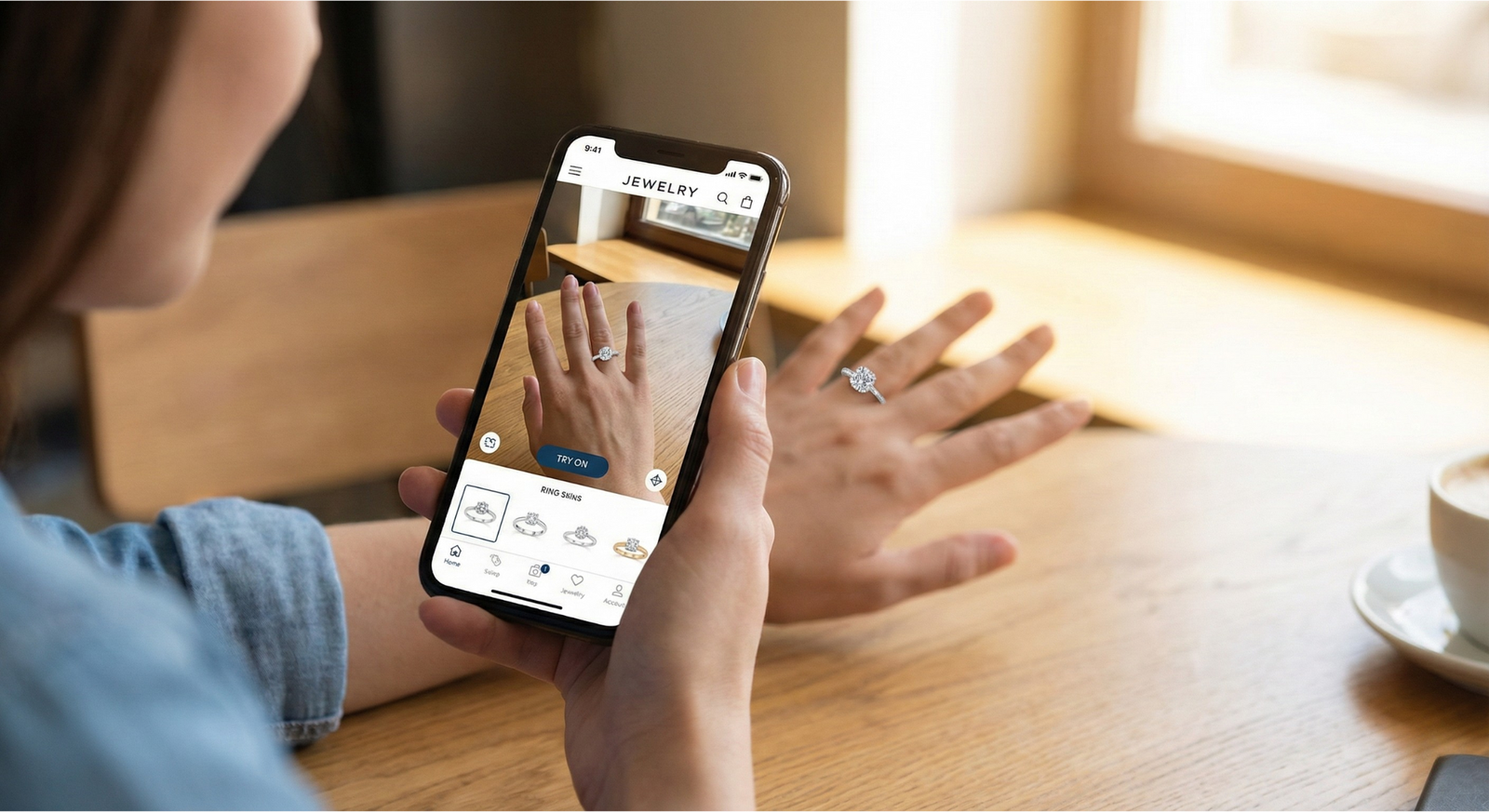
 2D vs 3D Try On Septum Rings: which is better for your store?
Quick Summary
- 2D = fast, cheap, and easily scalable for large catalogs; ideal for social and mobile.
- 3D = more accurate realism, reflections, and occlusion; suitable for premium SKUs and conversions.
- A hybrid strategy (2D for the majority, 3D for hero SKUs) often provides the best ROI.
- Run link-based A/B tests (e.g., tryitonme.com) to gauge real-world lift before major investments.
Introduction / Quick preview
Choosing between 2D vs 3D try on septum rings can feel like a technical rabbit hole — but for most merchants it’s a simple tradeoff between speed/scale and realism/conversion. In this guide you’ll get a practical decision framework: what each approach does, when 2D is enough, when to invest in 3D, and how to run fast no-code experiments using tryitonme.com’s link-based VTO. If you lead product, marketing or e‑commerce for jewelry or piercing brands, read on — you’ll walk away with checklists, A/B test plans, and a clear path to launch live try-on links in days, not months.
2D vs 3D try on septum rings has become a real merchandising question as shoppers expect interactive previews for small, reflective jewelry. Augmented reality and virtual try-on improve confidence for piercings and fine jewelry, but the right format depends on product type and channel. For background on how retailers are using VTO for unique piercings, see Perfect Corp’s overview: Perfect Corp — unique piercings & virtual try-on. Practical nose-ring examples and tradeoffs are covered by Glamar’s nose-ring guidance: Glamar nose-ring try-on.
What is 2D try on?
Definition and how it works
2D try on uses image compositing — flat images (PNGs with alpha channels) are positioned over a live camera feed or photo using facial landmarks (nose tip, nostrils, philtrum) to fit the overlay. The academic fundamentals of landmark-based fitting and AR compositing are discussed in facial-tracking literature: PMC — facial-tracking research. Industry examples for piercing overlays show how simple assets map to quick mobile filters: Perfect Corp — piercing overlays and practical implementation notes appear in Glamar’s post: Glamar — nose-ring practical notes.
Typical asset needs
- Front-view PNG with alpha transparency (high‑res)
- Optional side-view PNGs for multi-angle 2D sprites
- Product SKU metadata (size, finish, color swatches)
Pros
- Speed & cost: assets can be made in hours with image editors → rapid rollout for many SKUs. See Perfect Corp on scale and speed: Perfect Corp.
- Mobile & social friendly: lightweight overlays load fast on browsers and social apps (Glamar): Glamar.
- Easy catalog coverage: ideal when you need a large assortment live quickly.
Cons
- Limited realism: lacks volumetric depth; tilts and rotations can reveal flatness (landmark-based limits described in research): PMC facial-tracking.
- Occlusion & fit errors: overlays can clip through nostrils or lips on certain angles (practical notes from Glamar): Glamar.

What is 3D try on?
Definition and how it works
3D try on places a volumetric mesh (GLB/GLTF) with PBR materials on the user’s tracked face, enabling real-time lighting, reflections, and occlusion. The same facial-tracking research that informs 2D also supports volumetric alignment and 3D fit: PMC — facial-tracking. Perfect Corp describes how 3D models capture materiality and motion for piercings: Perfect Corp. For practical nose-ring demos and industry examples, see Glamar: Glamar.
Typical asset needs
- 3D model files (GLB/GLTF) or CAD exports
- PBR textures for metal, gems, and roughness maps
- Optional scanned references or photogrammetry for ultra-realism
Pros
- Realism & fit: volumetric tracking handles occlusion and depth, improving perceived accuracy (Perfect Corp / technical background): Perfect Corp and PMC.
- Rotation & interaction: users can tilt and view reflections, and physics/hinge behavior can be simulated.
- Material fidelity: metals and gems reflect light more convincingly with PBR textures.
Cons
- Cost & time: modeling, texturing, and QA increase per‑SKU effort (Perfect Corp discusses asset effort): Perfect Corp. Pricing references: cermin.id pricing.
- Performance: heavier on device CPU/GPU; may lag on older phones or constrained browsers.
Why septum rings are a special case
Septum rings are small, sit in a narrow anatomical area, and often have reflective metal finishes — that combination raises precise alignment, occlusion and reflection challenges. Perfect Corp explains how piercings (including nose and septum) require careful handling of placement and reflections: Perfect Corp — piercings. Demo videos and community examples show how small errors become very visible on face close-ups (sample demos: YouTube demo 1 and YouTube demo 2). Industry jewelry VTO notes also emphasize the need for realistic metal rendering to convey value: Essential Beauty — virtual jewellery try-on.
What this means for product pages and social ads
- If shoppers expect close-up inspection and realistic shine (high-value hoops or gemmed clickers), 3D is likely to deliver the trust you need.
- If you’re running broad social ads or need a fast catalog rollout, 2D often suffices for initial discovery and lower-priced SKUs.
(If a specific claim lacks a formal source, treat it as industry observation.)
Head-to-head: 2d try on vs 3d try on for septum rings
Key comparison criteria (realism, fit, reflections, rotation, cost, scalability, performance)
Realism
2D: Basic blending, looks flat under tilt — limitations noted in landmark/compositing research: PMC and practical nose-ring notes: Glamar.
3D: Lifelike depth and dynamic lighting (see Perfect Corp).
Fit accuracy & occlusion
2D: Relies on landmarks; occlusion can break at angles. See tracker analysis: PMC.
3D: Volumetric tracking better handles occlusion and alignment (see Perfect Corp).
Reflections & material
2D: Static highlights baked into the PNG; won’t change with lighting.
3D: PBR textures reproduce specular highlights and metal behavior (see Perfect Corp).
Rotation / angles
2D: Limited; distortions appear on tilt (practical notes: Glamar).
3D: Supports 3D rotations and physics for hinged designs (see Perfect Corp).
Cost / time / scalability
2D: Low-cost, quick asset creation — scale hundreds of SKUs rapidly (see Perfect Corp).
3D: Higher per-SKU cost and longer lead times — typically more suitable for hero SKUs (see Perfect Corp and cermin.id pricing).
Performance & channel fit
2D: Lightweight and browser/social friendly (see Glamar).
3D: Best on modern devices and supported browsers; may require fallbacks.
Which is Better 2D 3D Try On?
Which is better 2d 3d try on? Neither is universally better — 2D wins for speed, scale, and mobile/social performance; 3D wins for realism and conversion on premium septum rings. The recommended approach is to test both using shareable links to measure impact (see Implementation guide). Sources: Perfect Corp and facial-tracking research: PMC.
Decision flow / checklist: When to choose 2D vs 3D
- Catalog size > 20 SKUs → start with 2D for broad coverage. (Perfect Corp)
- Budget per-SKU limited → 2D (PNG overlays). (cermin.id)
- Hero SKU / Premium price / Gemmed metal → prioritize 3D for realism.
- Time-to-market < 1 week → 2D.
- Mobile-first campaign or social ads → 2D for performance (Glamar).
- If unsure → run both as an A/B test on tryitonme.com links.
Lead magnet CTA: Download the “2D vs 3D decision checklist” to share with your team.
Hybrid & alternative approaches
- 2.5D / multi-angle sprites: render front + three-quarter PNGs to simulate depth without full 3D.
- Pre-rendered turntables/GIFs: low-cost rotation illusion for product pages.
- Selective 3D: reserve true 3D models for top 10–20% revenue-driving SKUs, keep the rest in 2D. (Perfect Corp, Glamar, vendor checklist: cermin.id checklist.)
Hybrid is often the best ROI: scale most SKUs with 2D, invest 3D where the lift justifies cost.
Measuring success & A/B testing
Key KPIs to track (and why)
- Click-through rate (CTR) on try-on links — measures initial interest.
- Try-on engagement rate (sessions per link, time-on-try-on) — shows interaction depth.
- Add-to-cart & conversion lift — primary business outcome (see Perfect Corp).
- Returns rate / fit-related returns — shows whether realism reduced fit uncertainty.
- Time-on-page / scroll depth — secondary engagement metrics.
A/B test plan (quick estimate)
- Pick 5–10 representative SKUs (mix of low, mid, hero).
- Split traffic evenly between 2D link and 3D link on product pages or via paid ads (use tryitonme.com shareable links).
- Run for 2–4 weeks (estimate; adjust per traffic) and evaluate KPIs.
For ROI-specific guidance on septum experiments and typical lift scenarios, see our septum ROI playbook: cermin.id ROI playbook.
Implementation guide using tryitonme.com
tryitonme.com offers ZERO-CODE, LINK-BASED VTO that you can deploy without SDKs or API work. The platform is designed for fast experiments across web, mobile, and social channels. For a deeper look at our jewelry-focused, no-code workflows, see tryitonme jewelry: cermin.id tryitonme jewelry.
Onboarding & launch (exact flow)
- Purchase a 6‑month package sized to the number of SKUs you need. (cermin.id RFP)
- Send standard product photos (for septum rings: high-resolution front PNGs and optional 3D files).
- The tryitonme.com team/AI handles all AR processing. (cermin.id checklist)
- You receive the unique, ready-to-use try-on link for deployment in under 3 business days.
Step-by-step quick start
- Prepare assets: PNGs for 2D; GLB/GLTF for 3D (common acceptable formats).
- Upload to tryitonme.com and request AR processing.
- Receive and test your shareable product link.
- Deploy links on product pages, in social DMs, in ads, and embed in checkout or chat. (Shopify integration notes)
- Run split tests and collect analytics via the link.
This zero-code workflow means you can launch a live 2D vs 3D experiment in days, not weeks. Start here: tryitonme.com.
CTA: Try a free no-code demo on tryitonme.com.
Case study / hypothetical example
Hypothetical example (labelled): PierceCo (hypothetical), a DTC septum brand, launched with 2D try on across 120 SKUs using tryitonme.com links. After two weeks they saw higher try-on engagement and an initial CTR lift. For premium hoops, PierceCo produced 3D GLB models for 8 hero SKUs and ran an A/B split via shareable links. Hypothetically, the 3D group showed larger conversion lift and reduced fit-related returns compared to 2D (illustrative only). They scaled to a hybrid model: 2D for catalog breadth, 3D for top revenue SKUs, deployed via tryitonme.com links for fast iteration. (Patterns: Perfect Corp.)
Visual assets & examples to include (asset checklist)
Ask design to produce these assets with the specified alt text:
- High-quality PNGs for 2D compositing (alt: “2d try on septum ring overlay”)
- 3D render GIFs/MP4s (turntable and on-face render) (alt: “3d try on septum ring with reflections”)
- Side-by-side comparison image (2D vs 3D) of the same septum SKU (alt: “2D vs 3D try on septum rings comparison”)
- Decision flowchart PNG (alt: “which is better 2d 3d try on?”)
- Screenshot/live-demo of a tryitonme.com shareable link (alt: “Tryitonme.com shareable 2D vs 3D try on septum demo”)
FAQs
Are 2D try on results accurate for septum rings?
Accurate for front-facing previews and quick discovery; less reliable for angle/occlusion fidelity. See facial-tracking research: PMC and practical notes: Glamar.
Do I need 3D models to get started?
No — you can start with 2D PNGs and upgrade selected SKUs to 3D later. See guidance from Perfect Corp.
Which is better 2D 3D try on for small metal accessories?
3D provides better realism and reflections, but 2D wins for scale and speed — test both to determine the business lift for your assortment.
How fast can I run a test with tryitonme.com?
You can get a ready-to-use shareable try-on link in under 3 business days after you submit assets (see tryitonme.com onboarding).
Why tryitonme.com is the Right Fit for Your Business
- ZERO-CODE, LINK-BASED deployment — no SDK or API integration required; share links anywhere: tryitonme.com.
- Fast time-to-market — purchase a 6‑month package, send standard photos, tryitonme.com handles AR processing, and you receive a unique try-on link in under 3 business days.
- Accuracy for accessory VTO — built specifically for small jewelry and accessories with both 2D and 3D workflows. (cermin.id.)
- Easy experimentation — shareable links let you A/B test 2D vs 3D across channels without developer lift.
CTA: Try a free no-code demo on tryitonme.com.
Conclusion & recommended next steps
2D vs 3D try on septum rings isn’t a binary decision: start with 2D for fast catalog coverage and mobile/social campaigns, then invest in 3D for hero SKUs where realism drives purchase confidence. Use a hybrid approach to maximize ROI, and run A/B tests with tryitonme.com’s zero-code links to measure real lifts. Ready to test? Try a free no-code demo at tryitonme.com and download our decision checklist to share with your team.
SEO & meta, image alt text, and keyword checklist
- H1 contains primary keyword: 2d vs 3d try on septum rings.
- Exact subheading “which is better 2d 3d try on” included above.
- Meta description (120–155 chars): Compare 2d vs 3d try on septum rings — when to choose each and how to run zero-code tests with tryitonme.com. Book a demo.
- Slug: /2d-vs-3d-try-on-septum-rings
- Image alt text examples provided in the Visual assets checklist.
- Required links used inline: Perfect Corp, PMC, Glamar, YouTube demos, Essential Beauty, tryitonme.com, cermin.id.
Tracking, measurement & follow-up content plan
Before you launch, instrument these analytics: clicks on try-on links, try-on engagement rate (sessions/time), add-to-cart, conversion rate, returns for fit issues, and scroll depth on product pages. Use the follow-up post template “Results from our 2D vs 3D septum ring A/B test” to publish learnings — include tables of CTR, conversion, and returns; visual side-by-side imagery; and actionable takeaways for merchandising. For KPI guidance and typical VTO metric categories, see Perfect Corp.
Ready to run a fast experiment? Book a demo and get a no-code shareable try-on link at tryitonme.com.