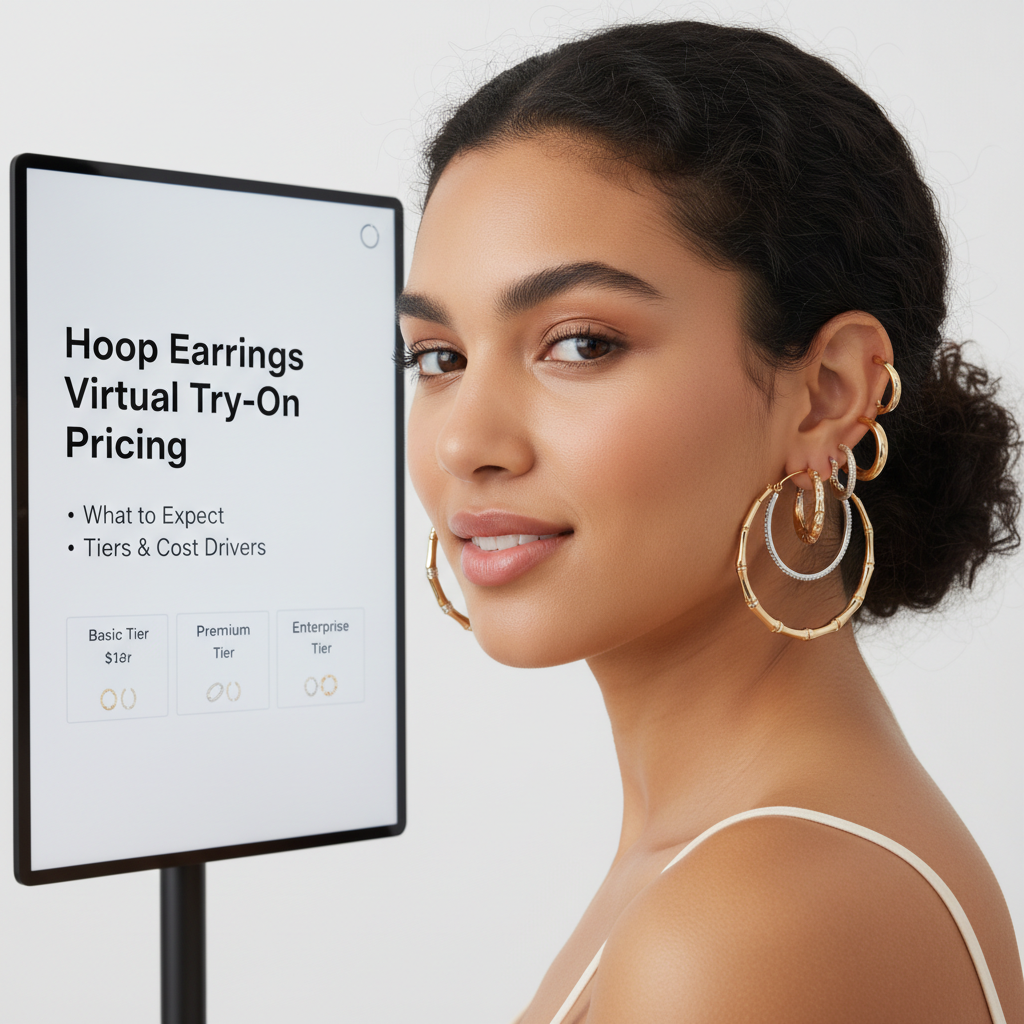
Hoop Earrings Virtual Try On Pricing: What to Expect, Tiers & Cost Drivers
Quick Summary
- Pricing is influenced by the number of SKUs, asset complexity (2D vs. 3D), and integration method (link-based vs. SDK/API).
- Common pricing models: subscription, per-SKU, usage/per-session, setup + maintenance, or enterprise plans.
Link-based (no-code) speeds up pilots and reduces engineering costs compared to SDK/API. - Rough estimates: basic plan $0–$500/mo, pro $500–$2,000+/mo, enterprise $2,000–$10,000+/mo; per-SKU $10–$500 depending on fidelity.
Introduction — What this guide covers and who should read it
If you’re budgeting for hoop earrings virtual try on pricing, this guide is written for eCommerce leaders, merchandisers, and marketing owners who need realistic cost ranges, package examples, and a clear way to compare vendors and plan a pilot. You’ll get practical pricing models, the main cost drivers, a simple ROI framework, and how a zero‑code, link‑based approach can cut both price and time‑to‑market.
We won’t promise fixed quotes (those come from a vendor demo), but you will leave with ballpark numbers, a checklist to choose a package, and next steps to run a low‑risk pilot or request a tailored estimate.
What is hoop earrings virtual try on and why it matters
Hoop earrings virtual try on is a camera‑ or photo‑based experience that lets shoppers visualize hoops on their own ears (or on model photos) before buying. These VTO experiences range from simple 2D overlays to full 3D/AR with ear tracking and occlusion. For a general industry overview of VTO approaches, see PRMal’s summary of virtual try-on options. For earring-specific pricing context and a broader ears/earrings pricing guide, see: earrings virtual try on pricing.
Why this matters to merchants
- Better customer confidence: Seeing size, scale and style on‑ear helps shoppers decide faster (merchant examples and VTO benefits are discussed by Trillion Jewelry).
- Lower returns: Visualizing fit reduces “not what I expected” returns (Trillion Jewelry highlights these benefits).
- Higher engagement & social sharing: Try‑ons encourage screenshots, social sharing, and longer session times (see Tinilux’s ear‑curation UX).
- Easier product customization flows: Some merchants combine try‑on with custom builders (Helzberg’s earring stack builder is an example: Helzberg earring stack builder). For guidance on adding jewelry try‑on to product pages (Shopify), see: jewelry try on Shopify.
Common pricing models for virtual try on
Virtual try on pricing follows several common structures. Vendors often mix these models depending on product scope and customer needs — be ready to compare apples to apples.
- Subscription tiers (monthly/annual): Flat platform fee by features, traffic, or SKU buckets (see typical vendor approaches at Trillion Jewelry).
- Per‑SKU fees: One‑time or recurring charges to create/host each try‑on asset (2D/3D).
- Usage / per‑session pricing: Charges based on impressions or sessions, common for campaign‑heavy brands.
- One‑time setup + maintenance: Implementation, QA, and onboarding fees (higher for SDK/API integrations).
- Enterprise/custom quotes: Bespoke packages for SLAs, white‑labeling, and systems integration.
Typical points of unpredictability: asset complexity (2D vs 3D), the number of SKUs, and whether the vendor requires SDK or API work for deployment.
Typical virtual try on packages and example tiers
Here are three example tiers to help you self‑select. Use these as decision maps — exact deliverables vary by vendor.
Basic package (example)
Best for: DTC startups and small boutiques testing VTO.
- Link‑based, no‑code VTO for a limited SKU set (e.g., 10–50 hoop SKUs).
- Standard photo‑based or lightweight AR try‑on.
- Basic analytics: sessions, interactions, CTRs to product pages.
- Standard email/ticket support.
Why choose it: Low monthly cost and fast pilot deployment without engineering. Good to validate impact before scaling.
Pro package (example)
Best for: Growing brands and mid‑market retailers.
- Support for more SKUs (e.g., 50–500).
- Enhanced tracking and analytics (conversion attribution, funnels).
- Branding/custom UI options and configurability (multi‑product try‑on or ear‑stack flows).
- Priority onboarding and support.
Why choose it: When VTO is a core part of the shopping experience and you want actionable data to optimize.
Enterprise package (example)
Best for: Large retailers, marketplaces, and global brands.
- Custom integrations with eCommerce platforms, CRMs, and apps.
- White‑labeling, SLAs, and dedicated customer success.
- Multi‑region, multi‑language support and professional services for asset creation.
Why choose it: For deep system integration, enterprise SLAs, and full service modeling.
Price ranges and sample estimates (transparent, with caveats)
Below are directional estimates — exact vendor quotes will vary by region, asset complexity, and service levels.
- Basic / link‑based packages: roughly $0–$500/month plus small per‑SKU onboarding fees for very small pilots.
- Mid‑tier / Pro packages: roughly $500–$2,000+/month, often with per‑SKU modeling or hosting fees.
- Enterprise solutions: roughly $2,000–$10,000+/month, especially with SLAs and custom integrations.
- Per‑SKU asset creation: approximately $10–$500 per SKU depending on 2D vs photorealistic 3D modeling and finish complexity (source context: Trillion Jewelry).
- Usage‑based pricing: commonly $0.01–$0.50 per session, with volume discounts.
Caveat: treat these as planning figures only. Ask vendors for line‑item quotes that separate platform access, asset creation, usage, and professional services.
Inputs that change cost — detailed breakdown
Understanding these drivers helps you budget and keep costs predictable.
- SKU count and variants
- Each size, metal finish, or stone may need its own asset. More SKUs = higher asset and hosting costs.
- Asset creation method (2D vs 3D)
- 2D overlays are inexpensive; photorealistic 3D costs more but can justify luxury pricing and higher AOV. (See Trillion Jewelry for asset complexity context.) See stud-specific pricing guidance here: stud earrings virtual try on pricing.
- Tracking & fidelity
- Basic placement vs advanced ear tracking and occlusion increases development and compute costs.
- Integration & deployment channels
- Shareable links (no‑code) keep integration costs minimal; SDK/API integrations add engineering time and testing.
- Customization & UX
- Branded UI, ear‑stack flows, and custom interactions require design and config work.
- Analytics & backend services
- Conversion attribution, A/B testing and personalization add platform complexity.
- Performance, SLAs & scalability
- High traffic and uptime guarantees increase recurring infrastructure fees.
- Localization & compliance
- Multi‑language and privacy/data handling requirements add scope.
Why tryitonme.com is the Right Fit for Your Business
- Zero‑code, link‑based deployment — no SDKs or API work required.
- Fast turnaround: onboarding flow (purchase a 6‑month package, send standard product photos, our team/AI handles AR processing, receive ready‑to‑use product links in under 3 business days).
- Accurate accessory VTO tailored for earrings, watches, jewelry, eyewear and hats. Learn about our no-code jewelry solution: tryitonme no-code jewelry VTO.
- Scales across web, mobile and social with the same shareable link.
- Transparent pricing tiers and quick pilots to validate ROI. See our pricing map: tryitonme pricing for accessories.
- Book a Demo: tryitonme demo — see pricing: tryitonme pricing — case studies: tryitonme case studies.
How tryitonme.com changes the cost equation
A link‑based approach reduces the usual line items that inflate quotes:
- No SDK/API integration fees: saves engineering hours and release cycles.
- Faster pilots: links deploy in days rather than weeks/months, reducing time‑to‑insight.
- Single asset/link for multiple channels: avoids duplicate builds for web, social and email.
Estimated example (hypothetical): avoiding a 40–160 hour engineering project could save thousands in developer costs and weeks of calendar time — actual savings depend on your team rates and project scope. For pricing and demo: tryitonme pricing and tryitonme demo.
ROI and example scenarios
A simple ROI formula:
- Incremental revenue = Traffic × Base CVR uplift × AOV
- Payback (months) = VTO monthly cost ÷ Incremental revenue
Example (hypothetical, assumptions labelled):
Boutique with 200 SKUs, 20,000 monthly sessions to hoop pages, AOV $120, and assumed CVR uplift of +10–20%: extra orders might be 20–40/month → incremental revenue $2,400–$4,800/month. At $500–$1,000/month VTO cost, payback can be under one month. These numbers are illustrative and should be validated with your own metrics.
Comparison — Link‑based (tryitonme.com) vs SDK/API providers
Pros (Link‑based):
- Faster implementation, minimal dev resources, predictable pricing, low maintenance, easy to trial and scale.
Cons (Link‑based):
- May have limits for ultra‑custom in‑app interactions or deeply embedded native experiences.
Pros (SDK/API):
- Max flexibility for deeply bespoke, app‑native features and offline integrations.
Cons (SDK/API):
- Higher setup costs, more engineering time, ongoing SDK maintenance, and potential vendor lock‑in. (Context: Trillion Jewelry.) For a head‑to‑head jewelry platform comparison, see: tryitonme vs Perfect Corp.
How to choose the right package for your brand — checklist
- SKU count: <50 → Basic; 50–500 → Pro; 500+ → Enterprise.
- Fidelity: 2D ok for mass market; 3D for luxury.
- Channels: web+social → link‑based; deep native apps → consider SDK.
- Dev resources: limited → link‑based; strong team → SDK may be justified.
Next step: pilot 10–30 high‑value SKUs with a link‑based package and measure lift. Book a pilot/demo: tryitonme demo.
FAQs — commercial questions buyers ask
Q: What affects the cost of hoop earrings try on?
A: SKU count, asset type (2D vs 3D), tracking fidelity, integration method, customization, analytics, and SLAs.
Q: Is there a per‑SKU fee?
A: Many vendors charge per‑SKU for modeling, especially for 3D; some packages bundle a SKU allotment.
Q: How long is setup with a link‑based solution?
A: Typically days to a few weeks depending on asset delivery — no app releases required.
Q: Can I use links in product pages, emails, and QR codes?
A: Yes — link‑based VTO is designed to be shareable across channels.
Q: Who creates the 3D/AR assets?
A: Options vary—vendors can model from photos or work from your CADs. Confirm asset services during your demo.
Case studies / social proof (short, hypothetical)
- Hypothetical: DTC hoop brand (80 SKUs) added link‑based try‑on to top 30 products and saw a hypothetical 10–15% uplift on those pages; incremental revenue offset costs quickly.
- Hypothetical: Multi‑brand retailer avoided a five‑figure SDK project by piloting link‑based VTO on premium hoop ranges and scaled based on measured lift.
For real client case studies, see: tryitonme case studies.
Closing / CTA
Hoop earrings virtual try on pricing is driven by asset complexity, SKU count, and integration approach. For many brands, a no‑code, link‑based model delivers strong value: lower upfront costs, fast pilots, and easy channel deployment. Ready to test? Book a demo or upload one hoop SKU to get a quick link‑based sample and a tailored price estimate: Book a demo — or review packages at Pricing.
Content & UX recommendations (editor/writer checklist)
- Required visuals: pricing tier table and a flow diagram comparing link‑based vs SDK flows.
- Recommended visuals: cost‑driver infographic, example VTO screenshots (hoops on models), and an optional interactive “estimate your cost” calculator (inputs: SKUs, fidelity, monthly sessions).
- Internal links to include: https://tryitonme.com/pricing, https://tryitonme.com/demo, https://tryitonme.com/case-studies, https://tryitonme.com/blog/vto-benefits.
- External links used in this article: PRMal, Trillion Jewelry, Helzberg, Tinilux.
SEO & keyword placement guidance
- Primary keyword: hoop earrings virtual try on pricing (H1 and within first 50–100 words).
- Secondary: virtual try on pricing, virtual try on packages, cost of hoop earrings try on.
- Use LSI terms: VTO, virtual fitting room, augmented reality shopping, accessory virtual try-on.
- Add FAQ schema and Product/Service structured data with dev support.
Measurement & follow-up (post‑publish)
- KPIs: page clicks, time on page, demo requests, pricing page visits, calculator interactions.
- A/B test CTAs (Demo vs Calculator). Suggested follow‑ups: deep dives on 3D modeling cost, SKU scaling case studies, and a “how we model one hoop” walkthrough.
If you want a fast, no‑code pilot to validate hoop earrings virtual try on pricing and ROI, request a demo: https://tryitonme.com/demo — or review packages at https://tryitonme.com/pricing.