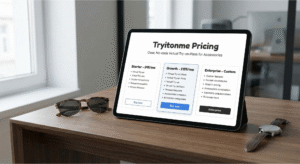
Tryitonme Pricing — Clear, No-Code Virtual Try-On Plans for Accessories
- Link-based, no-code VTO for accessories — deploy via shareable links without SDKs or engineering work.
- Six-month package model with predictable billing and team/AI asset processing for fast onboarding.
- Plans scale by SKU allowances and support level; enterprise quotes available for custom needs.
Table of Contents
- Introduction — tryitonme pricing
- Quick product summary — why tryitonme matters
- Pricing overview — VTO pricing philosophy
- At-a-glance tier list (tryitonme plans)
- Detailed plan breakdown
- Overage & usage limits
- Enterprise plans & custom pricing
- Implementation & time-to-value
- Use cases & sector examples
- Comparison & decision checklist
- FAQ
- CTA & next steps
Introduction — tryitonme pricing
tryitonme pricing is built for retailers and brands that want a no-code, link-based virtual try-on (VTO) for accessories — eyewear, jewelry, watches, and hats.
Read quick product examples for eyewear and jewelry: tryitonme eyewear virtual try-on and
tryitonme jewelry no-code VTO. If you want a way to let customers “try” products online without building an SDK integration, this post walks through the pricing philosophy, plan types, overage guidance, and enterprise options so you can pick the right package for your business.
You’ll get an overview of how tryitonme works (six-month package model — you supply standard product photos, our team/AI processes the AR, and we deliver a shareable try-on link), what drives costs, and the next steps to start a pilot or book a demo. For pricing details and to start a trial, visit tryitonme pricing or book a demo.
Quick product summary — why tryitonme matters
tryitonme pricing reflects a product designed to reduce engineering overhead and speed time-to-market for accessory VTO. The core deliverable is a shareable link-based try-on experience that works across channels without SDKs.
Elevator pitch
tryitonme delivers a no-code, link-based virtual try-on for accessories so you can deploy AR try-on across product pages, social, SMS, and email without SDKs or developer time. Learn more.
Key benefits that influence pricing
- Zero engineering cost: deploy via a shareable product link instead of custom SDK/API work.
- Fast setup: packages run on a fixed contract cadence and include AR processing by the tryitonme team/AI.
- Multi-channel coverage: the link-based approach works across web, mobile, and social — see mobile examples: mobile performance examples.
- Predictable billing: packages are sold per retrieval period (six-month packages) rather than hourly development.
- Scalable options: upgrade paths and enterprise quotes available for high volume or custom needs.
Pricing overview — virtual try on pricing philosophy
tryitonme plans are structured around two levers: usage (number of SKUs / VTO assets and expected impressions) and features/support (onboarding, SLAs, white-label options). The basic idea is to give predictable costs for a defined SKU set while allowing scale via upgrades or enterprise quotes.
For an at-a-glance look at current plan offerings and to start a trial, see tryitonme pricing. If you want a demo and a tailored enterprise discussion, request one here.
At-a-glance tier list (tryitonme plans)
- Starter — Trial-friendly: Small SKU sets, basic support, ideal to test top-selling accessories.
- Pro — Small brand growth: More SKUs, faster processing, basic analytics.
- Business / Growth — Retailers and DTC brands: Larger SKU allowances, priority support, multi-channel guidance.
- Enterprise — Custom: Dedicated onboarding, SLAs, SSO/white-label options. Quote required via demo.
Detailed plan breakdown (tryitonme plans)
Note: Exact limits, feature lists, and prices must be confirmed with product/finance before publishing. The following are descriptive guidelines for buyer self-selection.
Starter (tryitonme pricing)
- Target customer: Boutiques and small brands testing virtual try-on on a handful of SKUs.
- Key features: Link-based VTO for a small catalog, standard AR asset processing, basic support.
- Onboarding & support: Minimal onboarding; team processes product photos and delivers links.
- Billing cadence: Sold as a 6‑month package (confirm pricing with sales).
- How to start: Request a demo or trial.
Pro (virtual try on pricing)
- Target customer: Small DTC brands expanding VTO across product pages and social.
- Key features: Larger SKU allowance, priority AR processing, basic analytics.
- Onboarding & support: Guided onboarding, best-practice deployment tips.
- Billing cadence: 6‑month packages (confirm with sales).
- How to start: Book a demo.
Business / Growth (tryitonme plans)
- Target customer: Mid-market retailers and multi-brand merchants.
- Key features: Higher SKU limits, faster turnaround, analytics, multi-channel guidance.
- Onboarding & support: Priority onboarding and regular check-ins.
- Billing cadence: 6‑month packages with volume considerations.
- How to start: Contact sales at tryitonme contact.
Enterprise plan process (tryitonme plans)
- Target customer: Large retailers, omnichannel brands, platform partners.
- Typical features: Dedicated onboarding, SLA, SSO, white-labeling, custom integrations, volume discounts.
- Sales process: discovery call → scoping → pilot via shareable links → formal quote. Start here: book a demo.
- Price: Custom quote required.
Overage & usage limits (virtual try on pricing)
Most SaaS/usage models handle overages in one of three ways: per-unit overage fees (per extra SKU or extra view), automatic upgrades to the next tier, or negotiated custom billing. For forecasting, consider per-product costs when exceeding SKU allowance, per-impression fees for very high traffic, or upgrade triggers that move you to a larger plan.
tryitonme’s exact overage policy and mechanics should be confirmed with sales/finance — contact sales to confirm.
Enterprise plans & custom pricing
Enterprise customers typically need dedicated onboarding, security and compliance review (SSO, data policies), volume discounts, white-labeling, and pilot programs to validate performance using shareable links. The typical sales flow follows discovery → pilot → scoped quote. Start an enterprise conversation at tryitonme demo.
Why tryitonme.com is the Right Fit for Your Business
- Zero-code, link-based deployment — no SDK or API integrations required; deploy via a shareable product link.
- Fast setup: you supply standard product photos, our team/AI processes AR, and a ready-to-deploy link is delivered (link delivery timing noted in onboarding docs).
- Predictable 6‑month packages for planning and budgeting.
- Multi-channel ready — the same link works on web, social, SMS, and email.
- Expert AR processing — tryitonme team/AI handles asset creation to reduce internal workload. Book a demo.
Implementation & time-to-value (tryitonme pricing)
Step-by-step checklist to get value fast:
- Choose pilot SKUs (top sellers or high-margin pieces).
- Capture standard product photos (front/side for eyewear; standard jewelry/watches/hats shots). See the photo guide: frame fit guide and blue light try-on examples.
- Send photos to tryitonme per onboarding instructions.
- tryitonme processes assets (team/AI) and delivers shareable try-on links (delivery in under 3 business days per onboarding docs).
- Deploy links on product pages, Instagram stories, SMS, or email and track engagement (analytics examples).
Use cases and sector examples (virtual try on pricing)
- Eyewear: Boutiques can start on Starter; multi-location retailers should consider Business. Deploy links on product pages and Instagram try-on stickers. Eyewear examples.
- Jewelry: DTC jewelers can test Pro for rings/necklaces; luxury retailers often choose Enterprise for white-label experiences. Jewelry VTO.
- Watches: Use Business for cataloged watch lines with multiple SKUs per style.
- Hats: Fast-moving fashion brands can deploy Starter or Pro for seasonal collections.
Overage & scaling recommendations (forecasting)
Practical tips to forecast: estimate VTO impressions = product page visits × % visitors shown VTO × expected engagement rate; set alert thresholds (e.g., 80% of SKU allowance) to trigger upgrades; start low for pilots and monitor closely.
Comparison & decision checklist (tryitonme pricing)
6-item checklist before you decide:
- Budget (total spend and cadence)
- Catalog size (number of SKUs to activate)
- Traffic (expected impressions on product pages)
- Need for SLAs/white-labeling
- Internal integration resources (engineering available?)
- Speed to market (how fast you want to be live)
Trust signals & social proof
See customer stories and case studies at tryitonme case studies. (Request 2–3 quotes and one short case study with verified metrics from the product/team for publication.)
CTA and next steps
Assets to include in the final blog post
- Responsive pricing table graphic (plans and 1-line features).
- Sample VTO product link screenshot and short GIF demonstrating try-on.
- ROI mini-calculator or link for TCO comparisons.
- FAQ schema markup for page.
- Designer notes for mobile-first layout (link deployment examples).
SEO & on-page keyword plan
Primary placement: H1 and first paragraph use “tryitonme pricing”. Secondary keywords to include: “virtual try on pricing”, “tryitonme plans”, “virtual fitting room”, “augmented reality shopping”, “VTO for e-commerce”. Internal links: pricing, demo, contact, case studies.
KPIs to measure post success
- Organic traffic to the blog page
- CTR from blog to pricing and demo
- Demo/trial signups attributed to the post
- Time on page and scroll depth
- Keyword rankings for “tryitonme pricing” and “virtual try on pricing”
Next steps for content production (action items)
Before publishing, confirm the following with product/finance/legal: exact plan names, SKU/feature limits, prices, overage policy, billing mechanics, enterprise SLA details, verified case study and customer quotes, screenshots/GIFs, and legal review. Label any unverified claims with “(no reliable source)” until confirmed.
Final note
This draft explains tryitonme pricing in practical terms and highlights the core value of a no-code, link-based virtual try-on solution. To finalize, replace placeholders with confirmed plan names, exact prices, overage rules, and verified customer metrics supplied by the tryitonme product and finance teams. Ready to proceed? Book a demo.
FAQ — common buyer concerns
Q: Do I need engineers to deploy tryitonme?
A: No — deployment is link-based and requires no SDK work. For enterprise integrations you can discuss options with sales: contact sales. For vendor selection and evaluating no-code options, see our vendor checklist: vendor checklist.
Q: How fast will my VTO links be ready?
A: The typical turnaround from product photos to a ready link is under 3 business days per internal onboarding documentation. Confirm timing with your onboarding specialist during setup.
Q: What happens if I exceed my SKU or impression allowance?
A: Common approaches include overage fees, automatic tier upgrades, or negotiated add-ons. Confirm specifics with sales: contact sales. Any concrete numbers shown in this guide are illustrative until validated by product/finance.
Q: Is there an enterprise SLA or custom security review?
A: Enterprise plans typically include SLAs and security reviews; confirm scope during your demo: book a demo.
Q: How do I start a pilot?
A: Starter: pick 5–10 top SKUs and book a demo. Provide standard product photos per the onboarding guide and the tryitonme team will process assets and deliver shareable links.
Q: Can I scale beyond six-month packages?
A: Yes — packages are designed as 6‑month cadences for predictable billing, with upgrade paths and enterprise custom quotes available for high volume or special requirements. Discuss options with sales: contact.