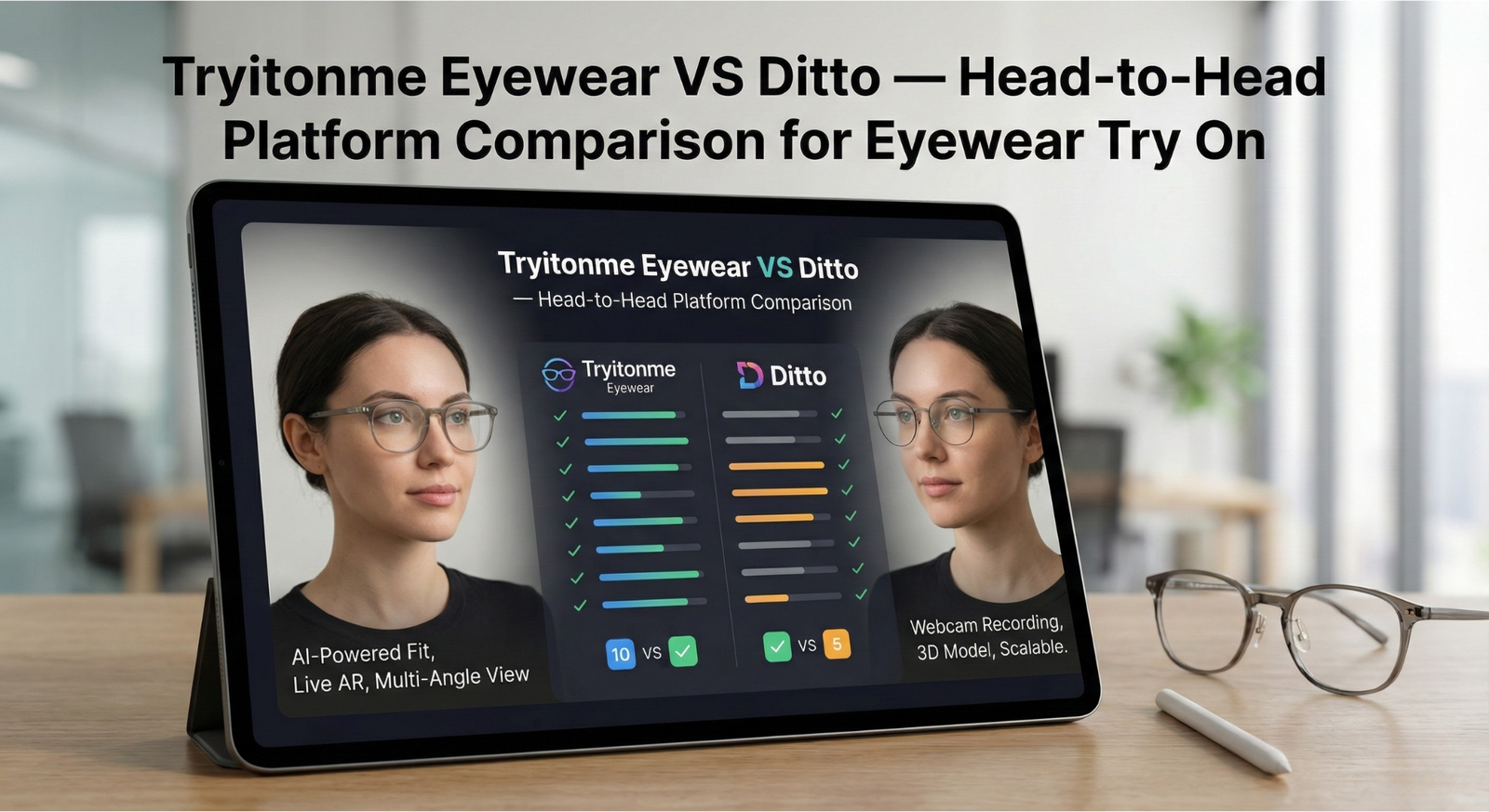
Tryitonme Eyewear vs Ditto — Head-to-Head Platform Comparison for Eyewear Try On
Quick Summary
- Tryitonme: a link-based, zero-code solution for rapid launch and distribution via SMS, chat, or social ads (see demo: tryitonme demo).
- Ditto: a robust SDK/3D vendor for on-site integration with publicly documented face-tracking and measurement capabilities (7×7 coverage, video demo).
- Options: start with a link-based pilot (tryitonme) for quick value testing; switch to an SDK like Ditto if you need 3D realism and depth integration on the product page.
- Mandatory testing methodology: ground-truth PD and frame dimensions, lighting scenarios, and mm error metrics for accuracy.
Introduction & goal of this comparison
This comparison of tryitonme eyewear vs. ditto is intended to help product managers, e-commerce leads, and marketing owners assess try-on eyewear options from a methodology, evaluation metrics, and practical recommendation perspective. We examined public documentation, vendor materials, and standard AR practices to develop evidence-based recommendations.
Executive summary: which solution fits which retailer
- DTC & social-first: Tryitonme is perfect if you need zero-code and a quick launch via link (see demo and features).
- Omnichannel & in-house engineering: Consider Ditto for 3D face tracking and deep integrations (read public coverage: 7×7 article; see video demo).
- Marketplaces / resellers: Choose based on distribution needs — link-based Ditto for chat/SMS/social, SDK for product page integrations.
Top strengths
tryitonme
- Zero-code, link-based deployment; fast to pilot (vendor states link available <3 business days after asset delivery) — see pricing and product features.
- Focus on accessories: eyewear, jewelry, watches, hats (vendor claim — verify with tryitonme.com or a sales representative).
Ditto
- Mature face measurement and 3D tracking with documentation and public demo (see 7×7, YouTube demo).
What is “eyewear try on” and why accuracy + UX matter
Eyewear try-on is a technology that allows customers to see glasses on their face through photos or a live camera. Accuracy and user experience determine whether virtual try-on increases conversions and decreases return rates.
Konsep kunci
- Pupillary distance (PD): The distance between the pupils, critical for optical centering — definition: Wikipedia: Pupillary distance.
- Fit/scale: The correct frame width and vertical placement to ensure the virtual frame aligns with the face.
- AR anchoring & tracking: How virtual objects are positioned and stabilized on the face (see AR fundamentals).
- 2D vs. 3D rendering: 2D is fast, 3D is more realistic and resistant to rotation/lighting — technical comparison: 2D vs. 3D tryon.
- Prescription workflow: Connecting VTO measurement data with the lens ordering process.
Quick product overviews: tryitonme and Ditto
tryitonme — product snapshot
Tryitonme offers link-based Virtual Try-On (VTO) without coding for accessories. Claimed onboarding flow: buy a 6-month plan based on the number of SKUs → send standard product photos → Tryitonme’s team/AI processes the AR → receive a unique try-on link in <3 business days (vendor claim — confirm in the feature or with sales). Demos and case studies: Tryitonme demo, case studies. Third-party overview: Cermin.id Tryitonme overview.
Ditto — product snapshot
Ditto is known for its 3D face‑tracking and measurement workflows, including facial point mapping and head size calibration capabilities. Public resources and demos are available: 7×7 article and demo video.
Why tryitonme.com is the Right Fit for Your Business
- Link-based VTO for cross-channel distribution (web, social, SMS, DM): live demo.
- Fast time-to-market (vendor claim: <3 business days after asset receipt) — verification during onboarding or sales.
- Accessory-first: positioned for eyewear, jewelry, watches, and hats (vendor claim — see features).
- Simple to pilot: 6-month plan per SKU (see pricing).
How we compare platforms — testing methodology & KPIs
Reproductive methodology recommendations:
- Vendor documentation, interviews, and public demos.
- Hands-on testing on iOS Safari, Android Chrome, and desktop in various lighting conditions (mobile performance guide: Cermin.id mobile performance).
- User testing by 12–20 testers with measured PD.
KPIs to collect
- Perceived fit accuracy & measured mm error vs ground truth.
- Face detection rate & stabilization (tracking).
- Time‑to‑interactive (TTI) and load performance (see Lighthouse).
- Conversion lift, return rate changes, and NPS.
Detailed comparison — accuracy & fit
Recommended testing steps:
- Create a ground-truth dataset: 10 frames with measured dimensions and 12–20 testers with measured PD.
- For each vendor, capture renderings and measure: horizontal scale error (mm), PD alignment error (mm), vertical placement, and tilt.
- Report the average mm error and the percentage within a threshold (e.g., ±3 mm).
PD as a technical definition : Wikipedia — Pupillary distance.
Visual realism & rendering — materials, occlusion, lighting
Evaluate realism in materials (metal/gloss/plastic), shadowing, environmental lighting response, and handling of occlusions such as hair or noses. ARKit guide to occlusion/anchoring: ARKit docs.
Onboarding & implementation speed — zero‑code vs SDK
Tryitonme claims a zero-code and link-based flow (see onboarding), while SDK vendors like Ditto require engineering time for integration. SDK timeline estimates vary by scope and are not standardized—ask the vendor for a project timeline.
Cross-channel compatibility — links vs SDKs for social & web
Shareable links support distribution in ads, SMS, Instagram/FB DMs, email, and live chat (social commerce guidance: Facebook Commerce docs). Example link: tryitonme demo link. The SDK is more integrated but limited to channels that allow custom code.
Shopper UX: live camera, image upload, onboarding guidance
- Live camera with clear permission guidelines.
- Image upload as a fallback for privacy/low-camera users.
- Onboarding overlays for PD capture/measurements.
- Accessibility & AR best practices: W3C WAI.
Analytics & A/B testing — how to measure VTO ROI
Key metrics: try-rate, time-on-try, conversion lift, returns by SKU, and net revenue per visitor. Integration with GA4 ecommerce: GA4 ecommerce. Examples of analytics & ROI resources: Cermin.id analytics and ROI guidance.
Pricing models & total cost of ownership
Common models: per-SKU packages, monthly SaaS, or licensing + implementation. tryitonme pricing: tryitonme pricing. Ditto pricing is not publicly available — request a vendor quote for 12–24 month TCO.
Privacy & compliance — face data handling
Ask the vendor if the images are ephemeral or stored, how long they’re stored, and their retention policy. Legal references: GDPR basics and CCPA overview.
Support & SLAs — onboarding, customizations, response times
SLA checklist: time to first response, escalation path, uptime targets, bug fix SLA, and onboarding milestones. Request a sample SLA from the vendor. Checklist example: vendor checklist.
Platform comparison matrix — criteria, scores, rationale
Downloadable scoring template: compare‑matrix.xlsx. Kolom contoh: Accuracy, Realism, Onboarding Time, Cross‑channel, Analytics, Price, Privacy (skala 1–10).
Run your own test: script, sample set, scoring rubric
Quick steps:
Select 10 frames with diverse SKUs.
Recruit 12–20 testers with measurable PD.
Test indoors in low light, outdoors in bright light, head tilt, and movement.
Capture metrics and use weightings: Accuracy 35%, Realism 25%, Implementation 15%, Speed 10%, Analytics 10%, Price 5%.
Download test script & rubric: test‑rubric.pdf.
Retailer use cases: DTC launches to large omnichannel rollouts
Hypothetical example:
- DTC launch: Use the tryitonme link in Instagram ads to drive try-ons and measure conversion lift in a hypothetical 30 days.
- Omnichannel: Pilot 50 SKUs via social links, then integrate SDKs on product pages if ROI supports.
Pros and cons — tryitonme vs Ditto (quick reference)
tryitonme eyewear
- Pros: Zero-code link deployment; fast (vendor claim: <3 business days); accessory focus.
- Cons: Vendor claims require verification; SDK features and deep integrations may be limited.
ditto eyewear try on
How to choose: decision guide by business need
- Need the fastest time-to-market and social distribution? Start with a Tryitonme link pilot.
- Need deep on-site integration and 3D realism? Evaluate Ditto or a similar vendor’s SDK.
- Hybrid: Run a link pilot first to gauge value, then upgrade to the SDK if warranted.
SEO checklist — where to place the target keywords
- Title + first 1–2 sentences must contain the primary keyword: tryitonme eyewear vs ditto.
- Include “eyewear try on” in the intro and technical section.
- Meta title suggestion: “tryitonme eyewear vs ditto — Eyewear Try On Platform Comparison”.
- Meta description suggestion: “Compare tryitonme eyewear vs ditto for eyewear try on. Methodology, testing rubric, and recommendations.”
Visual assets & demo recommendations
Asset recommendations:
- Side-by-side videos of the same frame on both platforms.
- Screenshots of PD overlays and scale comparisons.
- GIF of the link-based flow (shareable link → live try-on).
- Downloadable checklist and scoring matrix for transparency.
CTAs & conversion flow — promote tryitonme without overselling
Primary CTA: Try a live tryitonme demo. Secondary CTA: Download test rubric. Use UTM parameters to track demo sources and pilot conversions.
Appendix — glossary, checklist, source links
- PD: Wikipedia — Pupillary distance
- ARKit fundamentals: ARKit
- GDPR basics: GDPR.eu
- Ditto article: 7×7
- Compare matrix & rubric: compare‑matrix.xlsx, test‑rubric.pdf
Next steps — tests, vendor docs, and asset production
- Run a 5‑SKU pilot with tryitonme (request pilot via tryitonme demo).
- Request official Ditto factsheet (see public demo: YouTube).
- Produce side‑by‑side video assets and fill out a scoring matrix for internal transparency.
FAQ
Q: Can link‑based VTO match SDK accuracy?
A: It depends on the AR processing and anchoring vendor. Ask the vendor to demonstrate mm accuracy and sample exports. There is no consistent public source for tryitonme accuracy figures—verify with the vendor.
Q: Are face images stored?
A: Vendors must clearly state their retention and processing policies and provide DPA/GDPR documentation. See GDPR reference: gdpr.eu.
Q: Will VTO handle prescriptions?
A: Prescription fulfillment is a separate commerce workflow that must be integrated with VTO measurement data. Ask your vendor for documented prescription workflows.
Q: How many SKUs should we pilot?
A: Initial recommendation 5–50 SKUs depending on goals: 5–10 for proof‑of‑value; 50 for scale omnichannel pilot.
Q: What devices/browsers should be tested?
A: Minimum: iOS Safari, Android Chrome, and major desktop browsers; also test different lighting conditions and upload fallbacks.
Author note: Statements labeled “(tryitonme claim — confirm with tryitonme.com or a representative)” are from vendor materials; public facts about Ditto are sourced in this article.